Key takeaways
- Find the best adventure e bike for trails, gravel, sand and snow. Compare fat-tire grip, motor power, battery range, suspension, payload and class limits.
The best adventure e bike is a fat-tire or all-terrain electric bike built to keep moving where paved roads end: loose gravel, dirt tracks, beach sand, muddy forest paths and packed snow. A real adventure bike pairs wide tires with a strong motor, a large battery, dependable brakes and a frame that can carry a rider plus gear.
Quick answer: for most riders, the strongest all-round shape is a full-size fat-tire bike with 26-inch by 4-inch tires, a 750W rated motor, a battery of at least 720Wh, hydraulic disc brakes and a front suspension fork. The Himiway Zebra and the GOTRAX Tundra fit that shape most closely, while the Aventon Aventure.2 adds a torque sensor and a more refined ride feel, and the Lectric XPeak 2.0 brings the same trail-ready layout in a lighter-feeling package. The Heybike Ranger 2.0 is the compact alternative, with 20-inch fat tires and a folding frame for riders who need to carry the bike in a vehicle.
Quick Picks
| Bike | Best for | Motor | Battery | Tires | Top speed |
|---|---|---|---|---|---|
| Himiway Zebra | Long-range trail and camp riding | 750W | 960Wh | 26 x 4 in | Up to 25 mph |
| GOTRAX Tundra | Big battery and heavy loads | 750W | 960Wh | 26 x 4 in | Up to 28 mph |
| Aventon Aventure.2 | Smooth power and everyday trail use | 750W rated, 1130W peak | 720Wh | 26 x 4 in | Up to 28 mph unlocked |
| Lectric XPeak 2.0 | Gravel roads and dirt tracks | 750W rated, 1310W peak | 720Wh, 960Wh long-range option | 26 x 4 in | Up to 28 mph |
| Heybike Ranger 2.0 | Folding fat-tire bike for vehicle transport | 750W rated, 1400W peak | 600Wh | 20 x 4 in | Up to 28 mph |
How to Choose
Motor power and class limits
Motor power decides how a bike climbs and how it behaves on soft ground. A 750W rated motor is the usual benchmark for adventure riding, because it gives enough torque for steep dirt climbs and for pushing wide tires through sand or snow. Peak power is the short burst a motor can reach for a few seconds, and it is often much higher than the rated figure. Several bikes in this guide list peak power well above 750W, and several list top assisted speeds above 20 mph. Under the federal definition of a low-speed electric bicycle, the limit is 750W and 20 mph, and some trails, parks and paths restrict Class 3 bikes.
Tires and traction
Tires are what make an adventure bike an adventure bike. Wide fat tires, usually 4 inches across, spread the weight of the bike and rider over a larger contact patch, so the bike floats over sand and snow instead of sinking and cutting in. Narrower all-terrain tires can work on hard-packed gravel, but they struggle on soft surfaces. Look for a knobby tread with widely spaced lugs that shed mud. Fat tires usually run at low pressure, roughly 12 to 20 psi, and dropping the pressure a little on sand or snow improves grip.
Battery size and real range
Battery size is measured in watt-hours, written as Wh. A larger number means more stored energy and, in general, more range, but claimed range figures are best-case estimates made on flat ground at low assist with a light rider. Real range on trails is lower, because fat tires create more rolling resistance, hills demand more power, and cold weather reduces battery output. As a rough guide, a 720Wh battery suits day rides on mixed terrain, while a 960Wh battery gives a useful margin for long days and cold conditions. A removable battery is a practical advantage: you can charge it indoors and remove it to make the bike lighter when you lift it onto a rack.
Suspension and brakes
Rough ground needs suspension and strong brakes. A front suspension fork with at least 80 mm of travel takes the edge off rocks, roots and ruts, and a lockout lever lets you firm the fork up on smooth pavement so your pedalling energy is not wasted. Full suspension adds comfort on very rough trails but also adds weight, cost and maintenance. For brakes, hydraulic disc brakes are the standard to look for on an adventure bike. They give stronger and more consistent stopping power than mechanical discs, which matters when a heavy bike is carrying a rider and gear down a steep dirt descent.
Frame, fit and payload
Adventure bikes are heavy, usually around 75 to 80 lb with the battery fitted, and they carry heavy loads, so the frame and the payload rating matter. A payload rating of 300 lb or more covers most riders plus a rack bag, water, tools and a spare tube. A step-over frame is stiffer, while a step-through frame is easier to mount when you are carrying a loaded rack. Check the recommended rider height range and the standover height before ordering, because fat-tire bikes have limited frame sizes and a poor fit is hard to fix later.
Weight, folding and transport
Think about how the bike will get to the trail. A full-size fat-tire bike does not fit easily in a small car, and at close to 80 lb it is a two-person lift onto a roof rack for many riders. A hitch-mounted rack rated for the weight of an electric bike is the usual answer. Folding fat-tire bikes pack into a car boot or a recreational vehicle, but the fold adds weight, and the smaller 20-inch wheels roll less smoothly over rough ground than full-size 26-inch wheels.
The Best best adventure e bike Reviewed
Himiway Zebra
The Himiway Zebra is the long-range workhorse of this group. Its headline feature is a 960Wh Samsung or LG battery, one of the largest packs fitted to a fat-tire adventure bike at this level, with a claimed range of up to 80 miles on pedal assist. The 750W geared rear hub motor makes 86 Nm of torque, which is enough to keep the bike moving up steep dirt climbs and through soft ground. The 26-inch by 4-inch Kenda fat tires, front suspension fork and hydraulic disc brakes complete a genuinely all-terrain package, and the 400 lb payload rating is the highest in this guide, so the Zebra suits heavier riders and riders who carry camping gear.
The trade-offs are weight and size. At 79 lb with the battery fitted, the Zebra is heavy to lift and to manoeuvre at low speed, and it needs a sturdy rack for transport. The top speed is listed at up to 25 mph when the bike is set to its faster mode, which is above the 20 mph federal limit for a low-speed electric bicycle, so check where that setting is allowed before you use it.
No verified Amazon ASIN was available for this model at the time of writing, so it is listed here named-only. Confirm the exact listing, frame style and colour before ordering.
GOTRAX Tundra
The GOTRAX Tundra matches the Zebra on battery size, with a 960Wh removable pack and a claimed range of up to 74 miles on pedal assist, and it pairs that with a torque sensor, which is unusual at this level. A torque sensor measures how hard you are pedalling and adjusts the motor output to match, so the assist feels natural on climbs and on loose surfaces instead of switching on and off in steps. The 750W Bafang rear hub motor, adjustable front suspension fork, hydraulic disc brakes and Shimano 7-speed drivetrain round out a strong specification, and the bike is available in step-over and step-through frames.
The Tundra is rated for a 300 lb payload, which is lower than the Zebra, and at 78.1 lb it is just as heavy to lift. The top speed is listed at up to 28 mph, which is Class 3 speed and above the 20 mph federal limit for a low-speed electric bicycle, so check trail and path rules in your area before riding it at full speed.
No verified Amazon ASIN was available for this model at the time of writing, so it is listed here named-only. Confirm the exact listing, frame style and colour before ordering.
Aventon Aventure.2
The Aventon Aventure.2 is the most polished bike in this guide. It uses a 750W rated rear hub motor with a 1130W peak output, a torque sensor, a 720Wh integrated battery and 26-inch by 4-inch fat tires, and it comes with fenders, a rear rack and integrated lights as standard, so it is ready for mixed trail and road use straight out of the box. The torque sensor gives the smoothest power delivery of any bike here, which helps on loose gravel and slick surfaces where a sudden surge of power would spin the rear wheel.
The peak motor figure is a partial fit to flag: 1130W peak is above the 750W federal limit for a low-speed electric bicycle, even though the rated power is 750W. The bike ships as a Class 2 machine with assist up to 20 mph, but it can be unlocked to Class 3, with pedal assist up to 28 mph, and that setting may not be allowed on every trail or path. The 720Wh battery is also smaller than the 960Wh packs on the Zebra and the Tundra, so the claimed range of up to 60 miles is shorter, and real trail range will be less again. At 77 lb it is still heavy, and the 4-inch tires add drag on pavement, so it is not the right pick for a rider who mostly rides smooth roads.
No verified Amazon ASIN was available for this model at the time of writing, so it is listed here named-only. Confirm the exact listing, frame style and colour before ordering.
Lectric XPeak 2.0
The Lectric XPeak 2.0 is the value-led trail bike in this group. It is a full-size 26-inch by 4-inch fat-tire bike with a 750W rear hub motor, a torque sensor, an 80 mm RST Renegade suspension fork, hydraulic disc brakes and a 720Wh battery as standard, with a 960Wh long-range battery offered as an option. The torque sensor and the hydraulic brakes are the parts that set it apart from cheaper fat-tire bikes, because they give natural-feeling assist and reliable stopping power on dirt descents.
Two figures need flagging. The motor is rated at 750W but lists a peak output of 1310W, which is well above the 750W federal limit for a low-speed electric bicycle, and the top assisted speed is listed at up to 28 mph, which is Class 3 speed. Check the class label and your local trail rules before riding at those settings. The standard 720Wh battery is also the smaller pack in this group, so riders planning long days should consider the long-range battery option, and should expect real trail range well below the claimed figure. Lectric sells mainly direct, with a reputation for helpful customer support, so check the exact configuration and the warranty terms before ordering.
No verified Amazon ASIN was available for this model at the time of writing, so it is listed here named-only. Confirm the exact listing, battery option and frame style before ordering.
Heybike Ranger 2.0
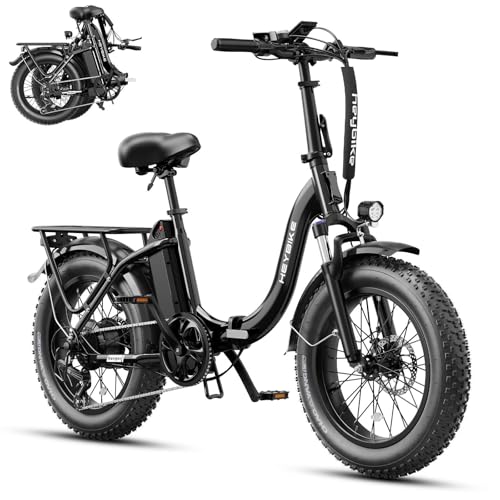
The Heybike Ranger 2.0 is the compact pick in this guide, and the only one with a verified Amazon listing at the time of writing. It is a folding step-through bike with 20-inch by 4-inch fat tires, a suspension fork, a 7-speed drivetrain, a removable 600Wh battery and a 330 lb payload rating, which is generous for a folding bike. The folding frame is the point: it packs into a car boot, a recreational vehicle or a closet, which makes it the easiest bike here to take on a trip.
Two partial fits need flagging clearly. First, the motor is rated at 750W, which sits at the federal limit, but the Amazon listing quotes a peak output of 1400W, and some listings for this model quote even higher peak figures, so the peak power exceeds the 750W federal limit for a low-speed electric bicycle and the figures vary between listings. Second, the listing quotes a top speed of up to 28 mph, which is Class 3 speed and above the 20 mph federal limit, so check where Class 3 bikes may ride near you. The 20-inch wheels are also a real compromise on rough ground: they roll less smoothly over rocks and ruts than the 26-inch wheels on the other bikes here, and the 600Wh battery is the smallest in this guide, so plan shorter rides. Confirm the exact model before ordering, because Heybike also sells a Ranger S 2.0 and a Ranger 3.0 Pro with different motors.
What to Check Before You Buy
Start with the class label and the rules where you ride. A bike that can reach 28 mph or that lists peak power above 750W may be restricted on some multi-use paths, in some parks and on some trails, and the rules change from state to state and from trail to trail. Next, confirm the exact variant: frame style, wheel size, battery size and motor rating can all vary within one model name. Check the payload rating against your weight plus your gear, check the rider height range, and make sure the bike will fit your transport: measure your vehicle or rack against the bike’s length and weight with the battery fitted. Inspect the bike on arrival before your first trail ride. Check that the brakes are firm, the wheels are true, the tires are inflated to the pressure printed on the sidewall, the battery locks in place, and every bolt is tight, especially the stem, the handlebars and the wheels. Carry a basic trail kit on every ride: a spare tube, tire levers, a pump, a multi-tool and water. Finally, store the battery indoors and charge it at room temperature.
FAQ
What makes an e-bike an adventure e-bike?
An adventure e-bike is built for unpaved ground. The defining features are wide fat tires, usually 4 inches across, a strong motor of around 750W rated power, a large battery, hydraulic disc brakes and a front suspension fork. City commuters use narrower tires and smaller batteries, and they are not built for sand, mud, snow or rough trails.
How far can an adventure e-bike go on one charge?
Claimed range figures are best-case estimates, measured on flat ground at low assist with a light rider. A 720Wh battery typically gives a useful day ride on mixed terrain, while a 960Wh battery gives a longer margin. Real range drops with hills, soft ground, cold weather, heavy loads and high assist levels, so treat the claimed figure as a ceiling, not a promise.
Do I need a 750W motor for trail riding?
For most adventure riding, a 750W rated motor is the right benchmark. It gives enough torque for steep dirt climbs and for pushing wide tires through sand and snow. Remember that peak power is a separate figure, and that a high peak figure can push a bike above the 750W federal limit for a low-speed electric bicycle.
Are fat-tire e-bikes good on sand and snow?
Yes, that is what fat tires are for. The wide contact patch spreads the bike’s weight, so the tires float over soft sand and packed snow instead of sinking. Dropping the tire pressure a little improves grip further. On deep, fresh snow or very soft sand, even a fat-tire bike will struggle.
Can I ride an adventure e-bike on public trails?
It depends on the trail and on the bike’s class. Many multi-use paths allow Class 1 and Class 2 bikes, which assist up to 20 mph, while Class 3 bikes, which assist up to 28 mph, are restricted on some paths and in some parks. Check the rules for each trail, check the class label on your bike, and ride at a speed that suits the other people using the trail.
Bottom Line
The best adventure e bike for most riders is a full-size fat-tire bike with 26-inch by 4-inch tires, a 750W rated motor, a battery of at least 720Wh, hydraulic disc brakes and a suspension fork. The Himiway Zebra and the GOTRAX Tundra lead on battery size and range, the Aventon Aventure.2 leads on ride feel and torque-sensor smoothness, and the Lectric XPeak 2.0 brings the same trail-ready layout with a strong component list. If you need to fold the bike into a vehicle, the Heybike Ranger 2.0 is the compact alternative, with the trade-offs of smaller wheels, a smaller battery and a peak motor figure that exceeds the federal limit. Whichever bike you choose, check the class rules for your trails and confirm the exact variant before ordering.
Disclosure: As an Amazon Associate, we may earn from qualifying purchases.