Our Short List of 3
- Best for: Home woodworkers who rip sheet goods and want a wide rip capacity with a rolling stand.
- 10-inch blade
- 15-amp motor
- 4,800 RPM no-load speed
- 32-1/2-inch rip capacity
- Best for: Small shops where the saw must fold away after each session.
- 10-inch blade
- 15-amp motor
- 4,600 RPM no-load speed
- Integrated folding stand

- Best for: Tight shops and builders who carry the saw to different work areas.
- 8-1/4-inch blade
- 15-amp motor
- 24.5-inch rip capacity
- Compact jobsite design
All 3 Picks at a Glance
| Product | Specs | Action |
|---|---|---|
| DEWALT DWE7491RS |
| Check price on Amazon |
| SKIL TS6307-00 |
| Check price on Amazon |
| DEWALT DWE7485 |
| Check price on Amazon |
Key takeaways
- Compare three quality table saws for home shops by rip capacity, fence accuracy, stand, and safety features, with specs taken from Amazon listings.
A table saw is the one tool that decides what the rest of a home shop can build. It rips long boards straight, cuts sheet goods to width, and sets the standard for every joint that follows. Buying one is therefore less about chasing the biggest motor and more about matching rip capacity, fence accuracy, and footprint to the work you actually do in the space you actually have. A saw that is too large crowds the shop, while one with a fence that drifts makes every cut a correction.
This guide is for home woodworkers setting up a first serious saw, for DIY builders who need straight rips for shelves and furniture, and for hobbyists replacing a small benchtop model with something steadier. Each saw below was picked from its name and specifications as stated on its Amazon product page, so you can check the same details yourself before ordering.
Quick Picks
As an Amazon Associate we earn from qualifying purchases.
| Product | Best for | Key spec from title |
|---|---|---|
| DEWALT DWE7491RS | Wide rips and a rolling stand | 32-1/2-inch rip capacity |
| SKIL TS6307-00 | A folding stand in a small shop | 4×4 cutting capacity at 90 degrees |
| DEWALT DWE7485 | A compact saw for tight spaces | 8-1/4-inch blade, 24.5-inch rip capacity |
How to Choose
Rip capacity and table size
Rip capacity is the distance from the blade to the fence at its widest setting, and it decides whether you can cut a full sheet of plywood in half or only trim narrow boards. A capacity around 24 inches handles most furniture parts and shelving, while a capacity above 30 inches lets you rip wider panels without a second setup. Table size matters just as much, because a short table gives a long board little support before and after the cut. Measure your shop floor and the longest boards you plan to cut, then check that the saw leaves room to walk around it and to feed stock through safely.
Fence accuracy
The rip fence guides every straight cut, so its accuracy is worth more than a slightly stronger motor. A rack and pinion fence moves smoothly and stays parallel to the blade as you slide it, which keeps cuts square without constant measuring. A fence that locks down firmly at both ends resists drifting when a board presses against it mid-cut. Before buying, read the listing for how the fence adjusts and locks, and look for a clear scale on the fence rail. A fence that is hard to read or slow to set will cost you time on every single project.
Motor and blade size
Most home-shop table saws run on a 15-amp motor, which is enough for hardwoods up to the saw’s stated cutting depth when the blade is sharp. Blade size decides that depth: a 10-inch blade cuts deeper than an 8-1/4-inch blade, so it handles thicker stock and wider bevel cuts. Smaller blades spin up faster and suit a lighter, more portable saw, but they limit the thickness you can cut in one pass. Match the blade to your material. If you mostly cut boards up to two inches thick, a compact saw is fine; if you cut thick slabs or large timbers, choose the full 10-inch size.
Safety features to check first
A quality table saw should arrive with a blade guard, a riving knife, and anti-kickback pawls, and you should use them whenever the cut allows. The riving knife sits just behind the blade and keeps the cut from closing on the blade, which is the main cause of kickback. Anti-kickback pawls grip the wood if it starts to move backward toward you. Always use a push stick for narrow rips so your hands stay clear of the blade, and never reach over a spinning blade to clear offcuts. Check the listing for which guards are included, and confirm replacements are available before you buy.
The 3 Best Options
DEWALT DWE7491RS
- Best for: Home woodworkers who rip sheet goods and want a wide rip capacity with a rolling stand.
- 10-inch blade
- 15-amp motor
- 4,800 RPM no-load speed
- 32-1/2-inch rip capacity
Home woodworkers who rip sheet goods and want a wide rip capacity with a rolling stand.
The rolling stand adds size and weight, so check that it fits through your shop door and stores where you plan to keep it.
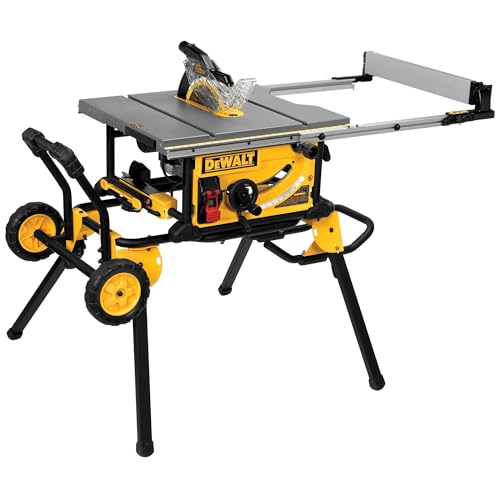
The DEWALT DWE7491RS is the most capable home-shop saw in this guide, built around a wide rip capacity and a rolling stand that folds for storage. Its rack and pinion telescoping fence adjusts smoothly and locks parallel to the blade, which makes repeat cuts faster and more consistent. The rolling stand carries the saw around the shop or out to the driveway, then folds down when the work is done. It suits a woodworker who rips sheet goods regularly and wants a full-size cutting capacity without giving the saw a permanent footprint.
Watch out for: The rolling stand adds size and weight, so check that it fits through your shop door and stores where you plan to keep it.
SKIL TS6307-00
- Best for: Small shops where the saw must fold away after each session.
- 10-inch blade
- 15-amp motor
- 4,600 RPM no-load speed
- Integrated folding stand
Small shops where the saw must fold away after each session.
The folding stand trades some table size for portability, so long boards need an extra support or a helper at the outfeed side.
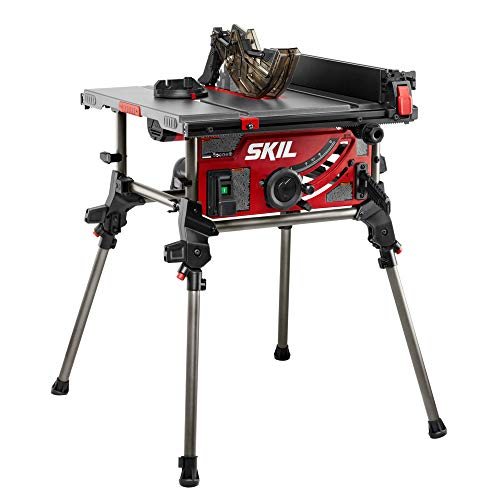
The SKIL TS6307-00 is a portable jobsite saw that fits a small home shop because its legs fold into the body for storage. Its rack and pinion fence rails keep the fence parallel to the blade, and its stated 4×4 cutting capacity at 90 degrees covers posts and thick stock that smaller saws cannot handle in one pass. The bevel range reaches from 2 to 47 degrees with positive stops at 0 and 45 degrees. It suits a builder who needs a real 10-inch saw but has to fold it away between sessions.
Watch out for: The folding stand trades some table size for portability, so long boards need an extra support or a helper at the outfeed side.
DEWALT DWE7485
- Best for: Tight shops and builders who carry the saw to different work areas.
- 8-1/4-inch blade
- 15-amp motor
- 24.5-inch rip capacity
- Compact jobsite design
Tight shops and builders who carry the saw to different work areas.
The smaller blade cuts less deeply than a 10-inch saw, so confirm the maximum cutting depth against the thickest stock you plan to cut.
The DEWALT DWE7485 is the compact pick in this guide, built for shops where floor space is the limiting factor. Its 8-1/4-inch blade and smaller body make it easier to carry and store than a full-size jobsite saw, yet its stated 24.5-inch rip capacity still covers most shelving and furniture parts. It is a sensible choice when the saw must share a bench or ride in a vehicle to a job, and when the material you cut rarely exceeds the depth of a smaller blade.
Watch out for: The smaller blade cuts less deeply than a 10-inch saw, so confirm the maximum cutting depth against the thickest stock you plan to cut.
Which One Fits Your Situation
You rip sheet goods in a garage shop
Choose the DEWALT DWE7491RS. Its 32-1/2-inch rip capacity handles wide panels, and the rolling stand lets you wheel the saw out for long cuts and fold it away afterward. The rack and pinion fence keeps wide rips parallel, which matters most when a full sheet is pressing against the fence.
Your shop is a shared space and the saw must fold away
Choose the SKIL TS6307-00. The integrated folding stand collapses quickly, and the 10-inch blade still cuts thick stock in one pass. Its 4×4 cutting capacity at 90 degrees covers posts and legs that a compact saw cannot manage, so furniture and framing work stays possible even when the saw lives folded against the wall between sessions.
You need a saw you can carry and store on a bench
Choose the DEWALT DWE7485. The compact body and 8-1/4-inch blade keep it light and easy to move, while the 24.5-inch rip capacity covers most shelving, trim, and cabinet parts. It is the easiest of the three to store on a shelf or in a vehicle, and it sets up quickly wherever the next cut happens.
You are replacing a small benchtop saw for furniture work
Choose the SKIL TS6307-00 if you need full depth and a folding stand, or the DEWALT DWE7491RS if you have room for the rolling stand and want the widest rip capacity. Both give you a 10-inch blade and a rack and pinion fence, which are the two upgrades that change furniture work the most.
Common Mistakes
- Choosing a saw by motor size alone and ignoring rip capacity, fence accuracy, and table size.
- Buying a saw that is too large for the shop, leaving no safe room to feed long boards through.
- Removing the blade guard or riving knife for convenience and leaving the saw unprotected against kickback.
- Cutting narrow strips without a push stick, which puts hands too close to the blade.
- Skipping a check of the included blade, fence, and stand, then finding a key part missing after delivery.
Frequently Asked Questions
What rip capacity do I need for a home shop?
A rip capacity near 24 inches covers most furniture parts, shelving, and trim work. Choose a capacity above 30 inches, such as the 32-1/2-inch capacity on the DEWALT DWE7491RS, if you regularly rip wide panels or cut sheet goods to width. Measure the widest boards you cut now, and add room for the larger projects you plan to take on.
Is a 10-inch blade better than an 8-1/4-inch blade?
A 10-inch blade cuts deeper, so it handles thicker stock and wider bevel cuts in one pass. An 8-1/4-inch blade suits a compact, portable saw and covers most boards up to about two inches thick. Choose the 10-inch size if you cut thick slabs or posts, and the smaller size if portability and storage matter more than maximum depth.
What does a riving knife do on a table saw?
A riving knife sits just behind the blade and keeps the two sides of a cut from pinching the blade as the wood passes through. That pinching is the main cause of kickback, where the wood is thrown back toward the operator. Keep the riving knife fitted for through cuts, and use it together with the blade guard and anti-kickback pawls.
Can I use a jobsite table saw as my only home-shop saw?
Yes, if its rip capacity and cutting depth match the material you use. A jobsite saw with a folding or rolling stand and a rack and pinion fence handles most furniture, shelving, and renovation work. A fixed cabinet saw suits a dedicated shop better, but for a shared garage or basement, a jobsite saw is often the more practical single saw.