Key takeaways
- Find the best smart room dehumidifiers for large bedrooms: Wi-Fi control, 50-pint capacity, and big-room coverage, compared by published specifications.
A large bedroom with damp air is hard to sleep in. The air feels heavy, bedding takes on a stale smell, and condensation can gather on windows overnight. A dehumidifier sized for the room changes that, and a smart model adds one more advantage: you can check the humidity, change the target level, and set a schedule from your phone instead of walking over to the unit in the dark.
The four models in this guide are all smart dehumidifiers built for large rooms. Each one lists Wi-Fi control through an app, each one removes 50 pints of moisture per day under the standard test conditions stated on its listing, and each one states coverage for a large space. Our top pick: Midea 50 Pint SMART Dehumidifier With Pump. Runner-up: hOmeLabs 50 Pint Wi-Fi Dehumidifier. This guide compares published specifications only: every capacity, coverage figure, and feature below comes from the product listing for that model, with nothing added from outside the listing.
At a Glance
| Product | Best for | Key specification |
|---|---|---|
| Midea 50 Pint SMART Dehumidifier With Pump | Built-in pump and app control | 50 pints per day, up to 4,500 sq. ft., Wi-Fi with MSmartHome app |
| hOmeLabs 50 Pint Wi-Fi Dehumidifier | Largest stated coverage | 50 pints per day, up to 7,000 sq. ft., Wi-Fi app control |
| Frigidaire Gallery 50-Pint Smart Dehumidifier | Voice control and custom humidity | 50 pints per day, Wi-Fi with Frigidaire app, Alexa and Google Assistant |
| GE Smart Energy Star Portable Dehumidifier 50 Pint with WiFi | Bucket alerts and Smart Dry | 50 pints per day, up to 4,500 sq. ft., Wi-Fi with SmartHQ app |
How to Choose
1. Match capacity to the room
All four models in this guide remove 50 pints of moisture per day under the standard conditions stated on their listings. That capacity is the right starting point for a large bedroom, because a smaller unit would run almost constantly in a big, damp room and still fall behind on humid nights. Check the capacity figure on the listing before anything else, and treat a model with a much lower daily capacity as a poor fit for a large bedroom, even if its smart features look appealing.
2. Check the stated coverage area
Capacity and coverage are not the same thing. Coverage tells you how large a space the maker says the unit is designed for, and the listings in this guide state coverage from 4,500 sq. ft. up to 7,000 sq. ft. For a large bedroom, any of these figures leaves plenty of headroom, which matters because a bedroom with an attached bathroom, a walk-in closet, or an open doorway to a hallway is effectively a larger space than its floor plan suggests. A unit with a higher stated coverage gives you more margin when the room is not sealed off from the rest of the home.
3. Confirm the smart features are real app control
A smart dehumidifier should let you do more than press buttons on the unit. Look for Wi-Fi control through a named app, so you can change the target humidity, set a timer, and check the current reading from your phone. The Midea model uses the MSmartHome app, the Frigidaire model uses the Frigidaire app, and the GE model uses the SmartHQ app. The hOmeLabs model lists Wi-Fi app control as well. Voice control through Alexa or Google Assistant is stated on the Midea and Frigidaire listings, which is useful when your hands are full or the unit sits across the room.
4. Decide how the water leaves the unit
Every dehumidifier collects water, and a large bedroom unit collects a lot of it. You have three choices: empty a bucket by hand, connect a gravity drain hose to a floor drain, or use a built-in pump to push water up and out through a hose. The Midea model in this guide includes a built-in pump, which is the most flexible option for a bedroom, where a floor drain is rarely nearby. The other three models list a removable bucket and a continuous drain connection, so you can choose between emptying the bucket and running a hose. Think about where the nearest drain or sink sits before you decide which approach fits your room.
5. Look at the humidity range you can set
A dehumidifier is only useful if you can set the humidity level you want. The Midea listing states an adjustable humidity range from 35 to 85, which covers the whole band most bedrooms need. For sleeping, a mid-range target keeps the air comfortable without drying it out, and the ability to set a precise number matters more than a long list of preset modes. Check that the listing states a humidity range or a set of target levels, and be wary of a model that only lists fan speeds without a humidity control.
6. Consider noise and night use
A dehumidifier runs in the room where you sleep, so its sound level and its night behavior matter. Look for a low fan speed setting and a timer, so the unit can run on a gentle setting overnight and switch off on a schedule. A washable filter, stated on the Frigidaire listing, also helps here, because a clogged filter forces the fan to work harder. None of the listings in this guide states a decibel figure for a quiet mode, so treat fan speed settings and the timer as your practical controls for nighttime use rather than relying on a single noise number.
7. Check the practical details: size, wheels, and filter
A 50-pint dehumidifier is a large appliance, and it will live in your bedroom for months at a time. Caster wheels make it possible to move the unit for cleaning or to a different corner of the room, and a front-removable bucket makes emptying simpler. A washable filter keeps running costs down, since you rinse it instead of replacing it. The listings in this guide state caster wheels and washable filters on several models, so compare these small details once the big numbers match, because they decide how easy the unit is to live with day to day.
8. Energy Star certification
All four models in this guide carry Energy Star certification on their listings. Certification means the unit meets the efficiency standard set for its class, which matters for an appliance that may run for hours every day during a humid season. It does not tell you exactly how much electricity a given unit will use in your room, since that depends on humidity, temperature, and how long it runs, but it is a useful baseline check when two models look similar on capacity and coverage.
Our Picks
Midea 50 Pint SMART Dehumidifier With Pump — ASIN B0B3PPRCC3
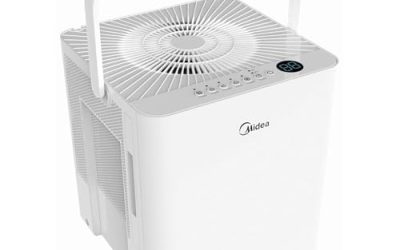
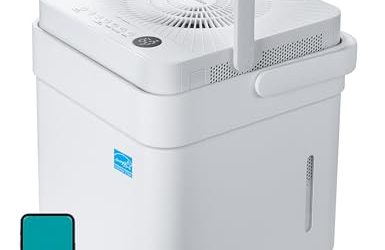
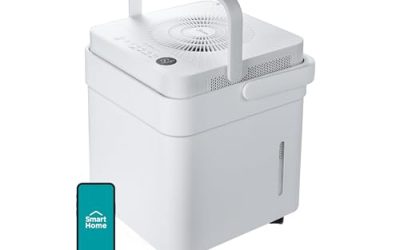
The Midea 50 Pint SMART Dehumidifier With Pump, model MAD50PS1WS, removes 50 pints of moisture per day and states coverage for rooms up to 4,500 sq. ft., which covers a large bedroom with room to spare. It is Wi-Fi enabled and controlled through the MSmartHome app on iOS or Android, and the listing states voice control through Alexa or Google Assistant. The adjustable humidity setting runs from 35 to 85, and the built-in pump pushes collected water through a hose, so the unit can drain upward to a sink or out a window without a floor drain nearby. It carries Energy Star certification.
Best for: A large bedroom where you want full app control and a pump, so the unit can drain without a floor drain and you can adjust it from bed.
Consideration: The pump and smart controls add complexity, so a buyer who wants the simplest possible unit may prefer a model with a plain bucket and hose drain instead.
hOmeLabs 50 Pint Wi-Fi Dehumidifier — ASIN B0D1H9DXJZ

The hOmeLabs 50 Pint Wi-Fi Dehumidifier, model HME1003, removes 50 pints of moisture per day under standard conditions and states coverage for spaces up to 7,000 sq. ft., the largest coverage figure in this guide. Its Wi-Fi control lets you manage humidity from your phone, and the listing states a 1.6-gallon water tank with auto shut-off when the tank fills. The unit is designed for bedrooms, bathrooms, laundry rooms, home offices, and basements, so a large bedroom sits well inside its stated range. The listing also notes a higher maximum removal rate under hot, very humid test conditions.
Best for: The largest bedrooms and open-plan sleeping areas, where the highest stated coverage gives the most headroom.
Consideration: This model has no built-in pump on its listing, so drainage relies on the removable bucket or a gravity drain hose, which needs a suitable low drain point.
Frigidaire Gallery 50-Pint Smart Dehumidifier — ASIN B07Z5QH2HL
The Frigidaire Gallery 50-Pint Smart Dehumidifier, model FGAC5044W1, removes 50 pints of moisture per day and connects over Wi-Fi to the Frigidaire app, so you can dehumidify the room from your smart device at any time. The listing states compatibility with Amazon Alexa and Google Home for voice commands, a custom humidity control, a timer, and a washable filter that is easy to clean. It also lists a continuous drain option alongside the removable bucket, and automatic shut-off when the bucket fills. The unit carries Energy Star certification.
Best for: A bedroom where voice control matters, with Alexa or Google Assistant handling humidity changes without touching the unit.
Consideration: The listing does not state a coverage area in square feet, so a buyer sizing for a very large or open-plan bedroom should weigh the 50-pint capacity figure rather than a coverage number.
GE Smart Energy Star Portable Dehumidifier 50 Pint with WiFi — ASIN B0C6L51RP9
The GE Smart Energy Star Portable Dehumidifier 50 Pint with WiFi removes 50 pints of moisture per day and states coverage for large rooms up to 4,500 sq. ft., including bedrooms. Built-in Wi-Fi connects to the SmartHQ app, where you can control and monitor the unit from anywhere, adjust humidity, set a schedule, and receive empty bucket alerts. Its Smart Dry feature automatically adjusts fan speed based on the humidity level in the room. The unit lists a removable bucket and a continuous drain connection for auto or manual drainage, and it carries Energy Star certification.
Best for: A bedroom where you want the app to watch the bucket and adjust the fan for you, with alerts instead of manual checks.
Consideration: The bucket alerts depend on the Wi-Fi connection and the SmartHQ app, so the alert feature needs the app set up and the unit connected to work as listed.
Which One Is Right for You?
Start with drainage. If your bedroom has no floor drain and you do not want to empty a bucket every day, the Midea model with its built-in pump is the straightforward choice. If you have a low drain point or you are comfortable emptying a bucket, any of the other three models will work, and the choice turns on smart features and coverage.
For the largest bedrooms, the hOmeLabs model states the widest coverage at up to 7,000 sq. ft., which gives the most margin in an open-plan room. For voice control, the Frigidaire model states Alexa and Google Home compatibility alongside its app, and the Midea model states voice control as well. For hands-off operation, the GE model pairs bucket alerts with Smart Dry fan adjustment, so the app tells you when attention is needed instead of you checking the unit. All four remove 50 pints per day, so capacity does not separate them, and the deciding factors are drainage, coverage, and how you want to control the unit.
Frequently Asked Questions
What size dehumidifier does a large bedroom need?
A large bedroom needs a unit with enough daily capacity and stated coverage to keep up on humid nights. The models in this guide each remove 50 pints per day and state coverage of 4,500 sq. ft. or more, which leaves headroom for a large bedroom, an attached bathroom, or a room that opens onto a hallway.
Does a smart dehumidifier need Wi-Fi to work?
Wi-Fi is needed for app control, remote monitoring, and alerts, but the basic dehumidifying function runs from the controls on the unit itself. Set the target humidity on the panel first, then connect the app when you want remote control, scheduling, or bucket alerts.
Can I run a dehumidifier in a bedroom overnight?
Yes, and a timer plus a low fan speed setting make overnight use practical. Set a target humidity in the middle of the adjustable range, use the timer to switch the unit off on a schedule, and keep the filter clean so the fan does not have to work harder than needed.
How does a built-in pump help in a bedroom?
A built-in pump pushes collected water through a hose to a higher drain point, such as a sink, or out a window. That matters in a bedroom, where a floor drain is rarely available, because it removes the need to empty a bucket by hand or find a low drain for a gravity hose.
What humidity level should I set in a bedroom?
The listings in this guide allow a wide adjustable range, with the Midea model stating 35 to 85. A mid-range target keeps the air comfortable for sleeping without drying it out. Start in the middle of the range and adjust in small steps until the room feels right.
Do I need a washable filter?
A washable filter is listed on several models in this guide, and it keeps running costs down because you rinse the filter instead of replacing it. A clean filter also helps airflow, so rinse it on the schedule stated in the product manual for the model you choose.
Bottom Line
For a large bedroom, the Midea 50 Pint SMART Dehumidifier With Pump is the strongest all-round choice, because it pairs 50-pint capacity and 4,500 sq. ft. of stated coverage with app control, voice control, and a built-in pump that solves bedroom drainage. The hOmeLabs model is the pick when coverage matters most, the Frigidaire model is the pick when voice control matters most, and the GE model is the pick when you want bucket alerts and automatic fan adjustment from the app. Any of the four fits a large bedroom on capacity, so choose by drainage first, then by how you want to control the unit.
Disclosure: As an Amazon Associate, this site earns from qualifying purchases.