Our Short List of 3

- Model: YTX20L-BS, manufacturer part YUAM320BS
- Type: AGM, bottle-supplied (BS), valve-regulated and non-spillable once activated
- Capacity: 18 Ah at the 10-hour rate, 18.9 Ah at the 20-hour rate per the Yuasa data sheet
- Cranking: 270 CCA
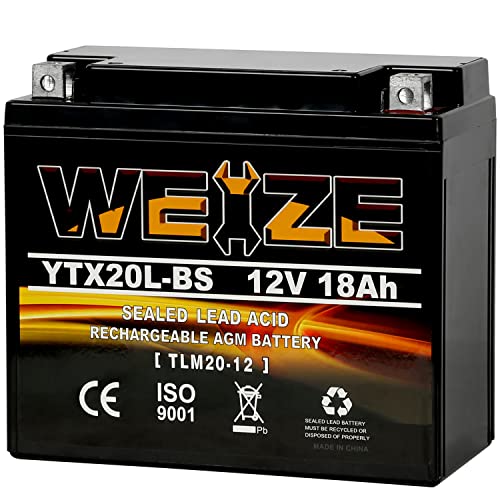
- Model: YTX20L-BS
- Type: sealed AGM, maintenance-free, listed as an ETX20L cross-reference as well
- Capacity: 18 Ah
- Cranking: 300 CCA

- Model: YTX20L-BS
- Type: sealed lead-acid AGM, rechargeable and maintenance-free
- Capacity: 18 Ah
- Cranking: 270 CCA
All 4 Picks at a Glance
| Product | Specs | Action |
|---|---|---|
| 1. Yuasa YTX20L-BS (YUAM320BS) — the factory-spec choice |
| Check price on Amazon |
| 2. Weize YTX20L-BS — sealed AGM with a higher listed cranking rating |
| Check price on Amazon |
| 3. Mighty Max Battery YTX20L-BS — the plain sealed replacement |
| Check price on Amazon |
 4. ExpertPower YTX20L-BS — the highest listed ratings, with a caveat |
| Check price on Amazon |
Key takeaways
- Compare the best WaveRunner battery replacements in the YTX20L-BS size Yamaha specifies for current models, plus the older YB16CL-B fitment, with CCA, capacity, dimensions, activation and charging guidance.
As an Amazon Associate we earn from qualifying purchases.
Affiliate Disclosure: This article contains affiliate links. If you buy through a link on this page, we may earn a commission at no extra cost to you.
A Yamaha WaveRunner that clicks, turns over slowly, or goes completely silent at the launch ramp almost always has a battery problem, and personal watercraft are harder on batteries than almost any other small vehicle. The battery sits in a hull that pounds through chop, gets sprayed, bakes in the sun between rides, and then sits unused for weeks or months while the riding season and the off-season pass. When it is time to replace it, the choice is not really about brand loyalty. It is about buying the exact size and terminal layout Yamaha specifies for your model year, with enough cranking power, in a sealed design that tolerates vibration and cannot spill in the hull.
This guide states the fitment plainly up front, because WaveRunner battery sizing changed over the model’s long life. Current Yamaha WaveRunner owner’s manuals — for the VX, VX HO, FX HO, FX SVHO, GP HO, GP SVHO, JetBlaster and SuperJet lines — list a 12-volt, 18 Ah battery of type YTX20L-BS. Older WaveRunners, broadly the 1987 to 2009 era, were specified with the larger YB16CL-B, a 12-volt, 19 Ah conventional battery. Those two sizes are not interchangeable without checking the tray, the hold-down and the terminal position, and the YTX20L-BS is physically shorter than the YB16CL-B it is sometimes cross-referenced against. Every pick below is a YTX20L-BS, the size current manuals call for, and the buying guide explains what an owner of an older YB16CL-B machine needs to check before ordering one, including the spacer question. Always confirm against your own owner’s manual before you buy: Yamaha’s own guidance is that the manual for your exact model and year has the last word.
All four picks are sealed AGM or SLA powersport batteries in the same size, so they compete on cranking amps, capacity rating method, activation, weight and maker support rather than on type. Specs below are taken from the product listings and manufacturer data sheets for each model, not from detailed research.
Quick comparison
| Product | Type | Capacity | Cranking | Activation | Best for |
|---|---|---|---|---|---|
| Yuasa YTX20L-BS (YUAM320BS) | AGM, bottle-supplied | 18 Ah at the 10-hour rate | 270 CCA | You fill and charge it | The factory-spec original-equipment choice |
| Weize YTX20L-BS | Sealed AGM | 18 Ah | 300 CCA | Sealed, maintenance-free format | Higher listed cranking amps in the same case |
| Mighty Max Battery YTX20L-BS | SLA AGM | 18 Ah | 270 CCA | Sealed, maintenance-free format | A straightforward sealed replacement |
| ExpertPower YTX20L-BS | SLA AGM | 20 Ah as listed by the maker | 330 CCA as listed by the maker | Sealed, maintenance-free format | Buyers comparing the highest listed ratings |
1. Yuasa YTX20L-BS (YUAM320BS) — the factory-spec choice
- Model: YTX20L-BS, manufacturer part YUAM320BS
- Type: AGM, bottle-supplied (BS), valve-regulated and non-spillable once activated
- Capacity: 18 Ah at the 10-hour rate, 18.9 Ah at the 20-hour rate per the Yuasa data sheet
- Cranking: 270 CCA
Yuasa is the battery maker Yamaha’s own documentation points to, and the YTX20L-BS is the exact type printed in current WaveRunner manuals, which makes this the lowest-risk pick on the list. If your manual says YTX20L-BS, this battery matches that line word for word: same case size, same terminal layout with the positive terminal on the right, same 18 Ah capacity at the 10-hour rate, and 270 CCA of starting power. There is no cross-reference table to interpret and no spacer arithmetic to do.
The trade-off is activation work, and it should not be glossed over. The BS suffix means bottle-supplied: the battery ships dry with its electrolyte in a separate container, and you fill it, let it stand, and charge it before first use. Yuasa’s listing is explicit that periodic charging is also required when the battery is not in use. That process is not difficult, but it does mean this is not a drop-it-in-tonight battery, and a battery that is filled and then put straight into service without its initial charge will not deliver its rated life. Owners who keep a suitable constant-voltage charger for valve-regulated batteries — the type Yamaha manuals call for — will find the routine familiar.
The construction is the reason to accept that extra step. Yuasa describes advanced lead-calcium technology that holds its specific gravity more than three times longer than conventional lead-antimony designs, and AGM separators that absorb the electrolyte so the battery is non-spillable. In a WaveRunner hull, where the battery is tilted, bounced and sprayed, a sealed, spill-proof case is not a luxury feature; it is the baseline requirement, and this design meets it.
Choose this one if your WaveRunner’s manual lists the YTX20L-BS, you want the original-equipment maker’s own battery, and you are willing to fill and charge it properly before the first ride.
2. Weize YTX20L-BS — sealed AGM with a higher listed cranking rating
- Model: YTX20L-BS
- Type: sealed AGM, maintenance-free, listed as an ETX20L cross-reference as well
- Capacity: 18 Ah
- Cranking: 300 CCA
The Weize YTX20L-BS keeps the same case size and the same 18 Ah capacity as the Yuasa above, and lists a higher cranking figure of 300 CCA. On paper that extra margin is useful in the exact situation WaveRunner owners know well: the first start of the season, on a cool morning, after the craft has sat. Cranking ratings are maker-reported and are not measured under identical conditions by every brand, so treat the gap as a listed difference rather than a proven one — but if two batteries share a size and a capacity and one lists more cranking amps, that is a legitimate reason to shortlist it.
The format is the other difference. This is a sealed, maintenance-free AGM battery rather than a bottle-supplied unit, so there is no acid pack to handle and no filling step before installation. It still needs to be charged and checked before use like any powersport battery that has been shipped and stored, and it still needs a maintenance charge over a long off-season, but the path from box to hull is shorter.
Weize sells this size across motorcycles, ATVs, UTVs and snowmobiles as well as personal watercraft, which is normal for the YTX20L-BS group size — the size is a shared powersport standard, not a Yamaha-only part. What matters for a WaveRunner is that the dimensions and the L polarity match: the L in YTX20L-BS denotes the terminal arrangement, and a non-L version of the same case puts the terminals on the wrong sides for many WaveRunner cable runs. This listing is the L version.
Choose this one if you want the factory size in a sealed, ready-format battery and you value the higher listed cranking rating for cold first starts.
3. Mighty Max Battery YTX20L-BS — the plain sealed replacement
- Model: YTX20L-BS
- Type: sealed lead-acid AGM, rechargeable and maintenance-free
- Capacity: 18 Ah
- Cranking: 270 CCA
Mighty Max Battery’s YTX20L-BS matches the Yuasa on the headline numbers — 12 volts, 18 Ah and 270 CCA — in a sealed SLA AGM case. That makes it the direct like-for-like alternative on this list: same group size, same capacity, same listed cranking power, but in a sealed maintenance-free format with no bottle of electrolyte to fill on the workbench.
For a WaveRunner, the sealed construction means no water to top up and no electrolyte that can slosh or spill when the hull takes a hit from a wake. Vibration resistance decides how long a PWC battery actually lasts, and an AGM design, with the electrolyte held in glass mat separators compressed against the plates, is the standard answer to that problem in this size class.
Check the width before ordering. This listing gives 3.50 inches where the Yuasa data sheet gives 3 7/16 inches for the same nominal size — a small difference that can matter in a tight tray. Measure your tray and compare all three dimensions plus the terminal position, rather than trusting the size code alone.
Choose this one if you want factory-matching capacity and cranking figures in a sealed battery and you have confirmed the tray dimensions on your craft.
4. ExpertPower YTX20L-BS — the highest listed ratings, with a caveat
- Model: YTX20L-BS
- Type: sealed lead-acid AGM, maintenance-free
- Capacity: 20 Ah as listed by the maker
- Cranking: 330 CCA as listed by the maker
ExpertPower lists its YTX20L-BS at 20 Ah and 330 CCA, the highest pair of numbers in this group, and it lists a 12-month coverage period in the product title. Those figures are the maker’s own, and they deserve the caveat that applies to the whole category: capacity can be quoted at different discharge rates and cranking figures under different test conventions, so a 20 Ah claim from one maker is not automatically more stored energy than an 18 Ah claim from another who measured at the stricter 10-hour rate. Yuasa, for comparison, quotes 18 Ah at the 10-hour rate and 18.9 Ah at the 20-hour rate for the same physical size, which shows how much of the gap can be rating method rather than chemistry.
None of that makes this a bad battery. It is a sealed AGM in the correct size, from a maker that publishes its cross-references openly, and the extra listed cranking margin is in the direction WaveRunner owners want for a big four-stroke that has sat for a month. It simply means the decision should rest on the fitment, the sealed construction and the coverage terms rather than on winning a numbers contest.
As with the Weize, confirm the L terminal layout and the case dimensions against your tray, and plan on a full charge before the first start. A sealed battery that has been in a warehouse is rarely at full charge when it reaches you, whatever the listing implies.
Choose this one if you want a sealed AGM in the factory size with the highest maker-listed ratings and a stated coverage period, and you are comfortable weighing those ratings as maker claims.
What about older WaveRunners that take the YB16CL-B?
If your WaveRunner is an older model whose manual lists the YB16CL-B, read this section before ordering anything above. The YB16CL-B is a bigger battery: Yuasa’s data for it gives 19 Ah at the 10-hour rate, 240 CCA, and dimensions of about 175 mm long, 100 mm wide and 175 mm tall. The YTX20L-BS is about the same length but much narrower and roughly 20 mm shorter. Yuasa’s own cross-reference material treats the YTX20 family as an optional upgrade path for YB16CL-B applications, with a spacer required to make up the height difference and a note that some modification to the hold-down may be necessary; Yuasa also sells a taller high-performance variant in the same family specifically with a spacer for YB16CL-B replacement.
In practice that means three checks. First, the tray and hold-down: a shorter, narrower battery that is not secured will move in the hull, and movement is what kills PWC batteries. Second, the cables: confirm they reach the terminals in the L layout without strain. Third, the capacity step: you would be moving from a 19 Ah specification to an 18 Ah one, which is small but real. If any of those checks fails, the correct answer is a YB16CL-B in the construction you prefer, not a YTX20L-BS forced into the space. Do not buy a battery in a different size on the assumption that the hull has room to spare.
How to choose a WaveRunner battery
Start with the size code in your owner’s manual, not with the battery that came out. A previous owner may have fitted whatever was on the shelf, and Yuasa’s own selection guidance warns that unless the battery in the vehicle is the original equipment, copying it is taking a chance. Match the full code, including the L, because that letter fixes the terminal sides.
Next, insist on a sealed design. Conventional flooded batteries that need filling and venting are a poor match for a hull that heels, pounds and takes spray. Every pick here is AGM or sealed SLA, which keeps the electrolyte absorbed, removes the watering routine, and tolerates being mounted and bounced in ways a vented battery should not be.
Then compare cranking and capacity honestly. Capacity in amp-hours tells you how much charge the battery holds for the starter, the bilge and the electronics; cranking amps tell you how hard it can deliver that charge on a cold start. Within one size, prefer the battery whose maker states the rate behind its capacity figure, and be sceptical of a large cranking advantage claimed without a test standard.
Finally, think about activation and charging, because they decide real-world life more than brand does. A bottle-supplied battery must be filled and charged correctly the first time. A sealed battery must still be charged before first use and maintained off-season. Yamaha manuals specify a special constant-voltage charger for these valve-regulated batteries, and using a charger intended for conventional automotive batteries can shorten life. Buy the charger question and the battery question together.
Charging, storage and safety
Charge a new battery fully before the first ride, following the maker’s instructions for filling if it is a bottle-supplied type. In the off-season, store the craft with the battery charged, disconnect it if your manual instructs that, and top it up periodically rather than leaving it to self-discharge for months; a lead-acid battery left flat sulfates, and sulfation is the most common reason a two-season battery behaves like a five-season one.
Work safely. Even sealed batteries contain sulfuric acid, and a bottle-supplied battery involves handling that acid directly: wear eye protection and gloves, keep sparks away from a charging battery, and never let a metal tool bridge both terminals. Take the old battery back for recycling when you buy the replacement.
Frequently asked questions
What battery does a Yamaha WaveRunner take?
Current Yamaha WaveRunner owner’s manuals list a 12-volt, 18 Ah battery of type YTX20L-BS across the VX, FX, GP, JetBlaster and SuperJet lines. Older WaveRunners from roughly 1987 to 2009 were specified with the YB16CL-B, a 12-volt, 19 Ah battery in a larger case. Check the specifications section of the manual for your exact model and year before ordering, because the two sizes differ in width and height.
Can I replace a YB16CL-B with a YTX20L-BS?
Sometimes, with conditions. Yuasa’s cross-reference material lists the YTX20 series as an optional upgrade for YB16CL-B applications, but the YTX20L-BS is shorter, so a spacer is needed and the hold-down may need modification. If the battery cannot be secured firmly, the cables cannot reach without strain, or your manual does not support the change, fit the YB16CL-B size instead.
Why does the terminal layout matter?
The L in YTX20L-BS fixes which side the positive terminal sits on — on the Yuasa, negative is on the left and positive on the right. WaveRunner battery cables are short and routed for that layout. A battery with the terminals reversed can force cables to stretch or cross, which risks chafing, poor connections and short circuits in a wet hull.
How long should a WaveRunner battery last?
Typically a few seasons, and storage habits decide it. A battery charged before storage, kept topped up off-season and secured against vibration will outlast an identical battery left flat in the hull all winter. Treat a battery that will no longer hold a charge after a proper full charge as finished.
Do I need a special charger?
Yamaha’s manuals say a valve-regulated lead-acid battery requires a special constant-voltage charger, and Yuasa likewise notes that its AGM batteries need periodic charging when not in use. Use a charger that states it is suitable for AGM or valve-regulated powersport batteries, and do not leave a basic unregulated charger connected indefinitely.
Should I consider a lithium WaveRunner battery?
Lithium batteries exist in this group size and are much lighter, but they need a compatible charging profile, their amp-hour figures are not directly comparable with lead-acid ratings, and Yamaha’s current manuals specify the lead-acid YTX20L-BS type. This guide stays with the size the manuals name. If you explore lithium, verify the charger and cranking rating first rather than swapping on weight alone.