Our Short List of 3
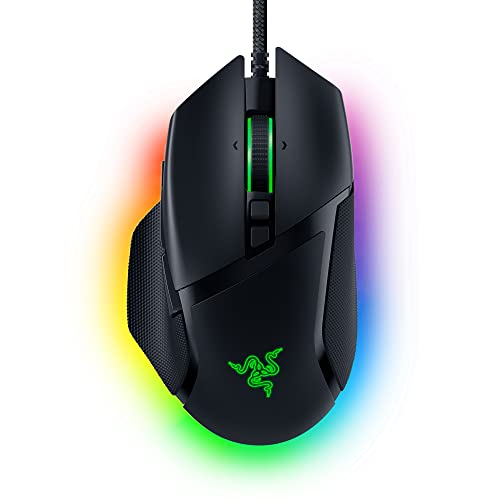
- Best for: Wired players who want the original HyperScroll wheel without charging or dongles.
- HyperScroll Tilt Wheel with free-spin and tactile modes
- Focus 26K optical sensor (26,000 DPI)
- 11 programmable buttons
- Razer Optical Mouse Switches Gen-2, 0.2 ms actuation, rated up to 70 million clicks
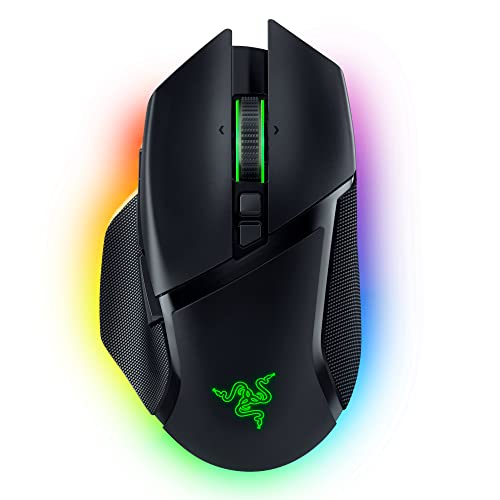
- Best for: Wireless players who want automatic wheel-mode switching and the fullest feature set.
- HyperScroll Tilt Wheel with free-spin, tactile and Smart-Reel modes
- Focus Pro 30K optical sensor (30,000 DPI)
- Razer Optical Switches Gen-3, rated for 90 million clicks
- 13 programmable controls

- Best for: Wired players who want Synapse wheel tuning and the newest Razer sensor.
- HyperScroll Tilt Wheel with tactile, free-spin and Smart-Reel modes
- Scroll tension and acceleration configurable in Razer Synapse
- Focus Pro 35K optical sensor (Gen 2)
- 13 customizable controls
All 4 Picks at a Glance
| Product | Specs | Action |
|---|---|---|
| Razer Basilisk V3 |
| Check price on Amazon |
| Razer Basilisk V3 Pro |
| Check price on Amazon |
| Razer Basilisk V3 35K |
| Check price on Amazon |
 Logitech G502 X Plus LIGHTSPEED |
| Check price on Amazon |
Key takeaways
- Free-spin wheels on gaming mice come from just two brands. Compare the Razer Basilisk V3 range and Logitech G502 X Plus by wheel mode, sensor and connection.
Start with an uncomfortable truth: almost every gaming mouse ever sold has an ordinary notched wheel, and a free-spin wheel that releases into a frictionless glide is a genuinely rare feature. On gaming mice it exists in only two brand families — Razer’s HyperScroll line and Logitech’s dual-mode wheel — so the real decision is not which of twenty mice to buy, but which implementation of the spin, and which sensor and connection, fit the way you play and scroll.
That honesty shapes this shortlist. It is written for gamers who flick through long inventories, weapon wheels and documents between matches, and who want the wheel itself to be the reason for the purchase. Every mouse below earned its place because its own Amazon listing states a free-spin or infinite scroll mode; models with celebrated names but ordinary ratcheted wheels were left out, however strong their sensors are.
Quick Picks
As an Amazon Associate we earn from qualifying purchases.
| Product | Best for | Key spec from title |
|---|---|---|
| Razer Basilisk V3 | Wired players who want the original HyperScroll wheel | HyperScroll Tilt Wheel, 26K DPI optical sensor |
| Razer Basilisk V3 Pro | Wireless players who want the fullest wheel feature set | HyperScroll Tilt Wheel, 30K DPI optical sensor |
| Razer Basilisk V3 35K | Wired players chasing the newest sensor generation | HyperScroll Tilt Wheel, Focus Pro 35K sensor |
| Logitech G502 X Plus LIGHTSPEED | Players who prefer a mechanical mode switch and tilt clicks | Infinite Scroll Toggle, LIGHTSPEED wireless |
How to Choose
How the wheel changes modes matters more than the spin itself
Both brands let the wheel run free, yet the switching experience differs. Razer’s HyperScroll wheels move between free-spin and tactile modes electronically, and the Pro adds a Smart-Reel behaviour that shifts modes automatically based on how fast you flick. Logitech’s dual-mode wheel changes state with a physical toggle behind the wheel, a mechanical click you can find without looking. Neither approach is wrong; the question is whether you want software-managed behaviour that adapts on its own, or a deliberate manual switch whose state you always know. Players who scroll long pages mid-game tend to feel this difference daily.
Tilt inputs turn the wheel into extra buttons
A free-spin wheel that also tilts left and right carries two additional programmable controls, and both families here offer that. In a shooter, tilt clicks can lean, swap equipment or trigger a push-to-talk without your fingers leaving the wheel. When comparing models, count total programmable controls rather than headline buttons, because the tilt inputs are easy to overlook in a spec table yet genuinely useful in play. Razer lists eleven programmable buttons on the wired V3 and thirteen controls on its newer models; Logitech lists thirteen buttons on the G502 X Plus.
Wired versus wireless changes nothing about the wheel
Cable or no cable, the spin mechanism is identical within each family, so connection should be decided on other grounds. Wired models remove charging from your routine entirely and suit a fixed desk. Wireless models free the mouse during the violent, low-sensitivity swipes where a cable drag is most annoying, and both wireless picks here use low-latency gaming connections rather than Bluetooth alone — though the Basilisk V3 Pro also offers Bluetooth for a second device. Decide by your desk and your tolerance for charging cables, not by the wheel.
Sensor generations are the real dividing line inside one family
Three of the four picks share a surname, so the sensor is what separates them. The wired Basilisk V3 carries the Focus 26K, the Pro steps up to the Focus Pro 30K, and the 35K model runs the second-generation Focus Pro 35K. In practice these are flagship-grade sensors whose differences show up in specification tables more than in aim, so buy the generation that matches your budget logic rather than assuming the biggest number transforms your game. Logitech counters with its HERO 25K, a mature sensor with a long competitive track record.
The 4 Best Options
Razer Basilisk V3
- Best for: Wired players who want the original HyperScroll wheel without charging or dongles.
- HyperScroll Tilt Wheel with free-spin and tactile modes
- Focus 26K optical sensor (26,000 DPI)
- 11 programmable buttons
- Razer Optical Mouse Switches Gen-2, 0.2 ms actuation, rated up to 70 million clicks
Wired players who want the original HyperScroll wheel without charging or dongles.
The cable is permanent; if your desk setup already annoys you with drag, look at the wireless Pro instead.
The wired Basilisk V3 is where HyperScroll started, and its listing describes the wheel plainly: it free-spins until stopped, or switches to a tactile mode for precision and feedback. Around that wheel sits an ergonomic right-handed shape with eleven programmable buttons, a Focus 26K optical sensor, and second-generation optical switches rated for seventy million clicks with 0.2 millisecond actuation. Because it is wired, the wheel never waits on a battery, and there is no dongle to lose. For a player who wants the free-spin experience in its most straightforward, always-ready form, this remains the entry point to the whole category.
Razer Basilisk V3 Pro
- Best for: Wireless players who want automatic wheel-mode switching and the fullest feature set.
- HyperScroll Tilt Wheel with free-spin, tactile and Smart-Reel modes
- Focus Pro 30K optical sensor (30,000 DPI)
- Razer Optical Switches Gen-3, rated for 90 million clicks
- 13 programmable controls
Wireless players who want automatic wheel-mode switching and the fullest feature set.
Battery-life figures attached to this model vary between sources, so check the current listing’s stated figure before relying on one.
The Pro takes the same wheel idea and removes the cable, then adds the cleverest mode logic in this guide. Its HyperScroll Tilt Wheel spins freely or locks into tactile steps, and a Smart-Reel mode automatically switches between them according to scroll speed, configurable in Razer Synapse. The sensor steps up to the Focus Pro 30K, the switches move to the third optical generation with a ninety-million-click lifecycle, and thirteen controls are programmable. Three connection modes — HyperSpeed wireless, Bluetooth and USB-C wired — let one mouse cover a gaming PC and a laptop without re-pairing rituals.
Razer Basilisk V3 35K
- Best for: Wired players who want Synapse wheel tuning and the newest Razer sensor.
- HyperScroll Tilt Wheel with tactile, free-spin and Smart-Reel modes
- Scroll tension and acceleration configurable in Razer Synapse
- Focus Pro 35K optical sensor (Gen 2)
- 13 customizable controls
Wired players who want Synapse wheel tuning and the newest Razer sensor.
This is a recent listing with a thinner track record than its siblings; confirm the live listing matches this exact model before ordering.
Think of the 35K as the wired formula refreshed around a newer sensor. Its HyperScroll Tilt Wheel offers tactile, free-spin and Smart-Reel modes, with scroll tension and acceleration adjustable inside Razer Synapse — a level of wheel tuning neither Logitech rival matches in software. The Focus Pro 35K optical sensor, second generation, headlines the specification, and the listing-derived record counts thirteen customizable controls. You give up nothing about the wheel by staying wired, and you gain the newest tracking hardware Razer sells in this shape. It is the pick for players who treat the wheel as a tunable instrument rather than a fixed feature.
Logitech G502 X Plus LIGHTSPEED
- Best for: Players who prefer a mechanical wheel-mode toggle inside Logitech’s ecosystem.
- Dual-mode scroll wheel: hyper-fast free spin and ratcheting modes, with left-right tilt
- HERO 25K sensor
- LIGHTFORCE hybrid optical-mechanical switches
- 13 programmable buttons
Players who prefer a mechanical wheel-mode toggle inside Logitech’s ecosystem.
POWERPLAY charging needs Logitech’s separate charging mat; out of the box, charging is by USB-C cable.
Logitech’s answer to the free-spin question is mechanical honesty: a redesigned dual-mode wheel that switches between hyper-fast free spin and precise ratcheting, and tilts sideways for two more personalisable controls. The G502 X Plus pairs that wheel with the HERO 25K sensor, LIGHTFORCE hybrid optical-mechanical switches and thirteen programmable buttons. LIGHTSPEED wireless handles the connection, the listing states up to 130 hours of battery life, and the mouse is POWERPLAY compatible for charging on a compatible mat. LIGHTSYNC RGB rounds out a package aimed at players who prefer Logitech’s software ecosystem and a physical mode toggle.
Which One Fits Your Situation
You scroll huge inventories and documents between matches
Pick the Basilisk V3 Pro. Smart-Reel is built for exactly your rhythm: flick hard and the wheel releases into free spin for the long haul, scroll gently and it settles back into tactile steps for short lists. No other pick automates that judgement, and doing it manually dozens of times an evening is precisely the friction you are trying to remove.
Your desk is fixed and you hate charging things
Pick either wired Razer. The original Basilisk V3 covers the free-spin brief completely, while the 35K adds Synapse wheel tuning and the newer sensor for players who enjoy dialling in tension. Both are ready the second you sit down, every day, with no battery anxiety attached to the wheel or anything else.
You already live inside Logitech’s software and gear
Pick the G502 X Plus LIGHTSPEED. The physical mode toggle suits players who want certainty about which mode the wheel is in, LIGHTSPEED keeps wireless latency off your mind, and POWERPLAY support means the mouse can charge on the mat you may already own. Its wheel tilts for two extra controls, matching the Razer trick inside your existing ecosystem.
You play on a PC and work on a laptop
Pick the Basilisk V3 Pro for its three connection modes. HyperSpeed serves the gaming rig, Bluetooth serves the laptop, and the wheel modes travel with the mouse between them. One device, one set of muscle memory, and no second mouse cluttering the bag — a small convenience that compounds across every working week.
Common Mistakes
- Assuming any mouse with a metal or fast-looking wheel free-spins; most wheels are ratchet-only, and the mode must be stated in the listing.
- Buying a productivity mouse for its famous free-spin wheel and discovering its polling and switches were never built for gaming.
- Ignoring the tilt inputs when counting buttons, then mapping controls to awkward keyboard keys the wheel could have handled.
- Choosing a wireless model without checking how it charges, or whether a charging-mat feature needs extra hardware you do not own.
- Treating the biggest sensor number as the biggest upgrade, when the wheel mechanism and mode switching are what you will actually feel.
Frequently Asked Questions
What does a free-spin wheel actually do in games?
It removes the ratchet from scrolling, so one flick sends the wheel gliding through long lists: weapon wheels, inventories, build menus and crafting trees move in one gesture instead of repeated finger strokes. Every mouse here also keeps a tactile mode for precise single steps, so you lose nothing when a menu demands one-item-at-a-time control. The benefit is speed with an escape hatch, not speed at the cost of precision.
Why are there only two brands in this guide?
Because only two brand families currently ship gaming mice whose listings state a true free-spin mode: Razer’s HyperScroll line and Logitech’s dual-mode wheel. Plenty of gaming mice have excellent ordinary wheels, and plenty of office mice free-spin, but the overlap of gaming hardware and a free-spinning wheel is this small. Padding the list with ratchet-only mice would make the page longer and the advice worse, so the shortlist stays honest.
Is Smart-Reel worth choosing the Basilisk V3 Pro for?
If you switch between long and short scrolling constantly, yes. Smart-Reel watches how fast you flick and changes the wheel’s mode for you, engaging free spin for fast gestures and tactile steps for slow ones, with the behaviour configurable in Synapse. Players who mostly stay in one mode — always free, always stepped — gain less, and can save the decision for the wired models or the Logitech instead.
Does the free-spin wheel wear out or feel loose over time?
The mechanisms here are electronic or mechanical mode switches, not a permanently loose bearing, so the wheel keeps its tactile mode as a reference point. Razer’s wheels switch modes electronically, and Logitech’s uses a physical toggle, which gives a clear, deliberate change of state. As with any moving part, buy from a current listing, keep the receipt, and treat the wheel’s feel in the first week as your quality check.