Key takeaways
- Compare the best smart room dehumidifiers for home offices, with Wi-Fi app control, quiet low fan speeds, humidity scheduling and flexible drain options.
As an Amazon Associate we earn from qualifying purchases
A home office shows excess humidity early: condensation on the window behind your monitor, paper that curls in the printer tray, a musty smell in a room that stays closed all day, and a sticky feeling that makes long work sessions uncomfortable. A basic dehumidifier fixes the moisture but adds a new chore, because someone has to switch it on, check the bucket, and remember to quiet it down before a call. The best smart room dehumidifiers for home offices remove that friction. They connect to Wi-Fi, follow a schedule in an app, hold a set humidity level on their own, send a phone alert before the tank fills, and shut off automatically when the bucket is full.
This guide compares five Wi-Fi dehumidifiers sized for single rooms, small offices, and larger open work spaces. Every pick can be controlled from a phone app, every pick has auto shutoff, and the differences that matter are capacity, noise on low fan speeds, tank size, and how each unit drains. The sections below explain how to size a unit for an office, then walk through each model with its strengths, trade-offs, and the situations it fits.
Quick Picks
| Product | Best for | Key spec |
|---|---|---|
| Midea Cube 20 Pint | Most single home offices | 3.2 gal bucket, SmartHome app and voice control |
| hOmeLabs 22 Pint Wi-Fi | An office plus adjoining rooms | 22 pints per day, slim 12 in width |
| GoveeLife Smart Dehumidifier (H7151) | Smart-home automations | Alexa, Google Assistant and IFTTT, humidity history graphs |
| Honeywell TP50AWKNR | Voice control and a sleep mode | 32 pints per day, anti-spill tank guards |
| hOmeLabs 8 Pint Wi-Fi | Small, quiet offices | About 38 dB on low, only 7.5 in deep |
How to Choose the Best Smart Room Dehumidifiers for Home Offices
Match capacity to the room, not the whole house
Dehumidifier capacity is rated in pints of water removed per day under a standard test. A closed office of 100 to 250 square feet with mild dampness usually needs only a compact unit in the 8 to 22 pint range. A basement office, an open-plan floor, or a room with a laundry area nearby pushes the requirement toward 30 to 50 pints. Oversizing is a real problem in small rooms: a large unit reaches the target humidity quickly, cycles on and off, and spends more time making compressor noise in short bursts. Undersizing is worse, because the unit runs all day without ever reaching the set point. Use the coverage figures in each listing as a ceiling, not a target, and size for the room the unit will actually sit in.
Use the app for scheduling, not just remote control
The smart feature that matters most in an office is the schedule. A good routine runs the dehumidifier hard early in the morning, holds the target humidity during work hours on a low fan speed, and pauses or slows during your regular call blocks. All five picks here connect over 2.4 GHz Wi-Fi and offer app control with timers; the GoveeLife and Midea apps also show the current humidity and tank status remotely, and the GoveeLife app keeps humidity history graphs so you can see whether the room spikes after rain or laundry days. Voice control through Alexa or Google Assistant is a secondary convenience for quick changes without opening the app.
Keep fan noise off your calls
Compressor dehumidifiers are never silent, and the fan is usually louder than the compressor on high speed. For an office, the practical approach is to dry the room before calls and let the unit idle at its lowest fan speed during them. Look for multiple fan speeds, a sleep or low mode, and a physical size that can sit a few feet from your desk rather than beside it. The compact hOmeLabs 8 Pint is rated at about 38 dB on its low setting, which is the quietest figure in this group; larger units do not publish a directly comparable low-speed rating, so plan placement accordingly and let scheduling do the heavy lifting.
Plan the drainage route before you buy
Every unit here can run in three ways: collect water in its bucket, drain continuously through a hose to a floor drain or sink, or, in the Midea Cube’s bucket-free arrangement, sit above a sink and drain directly. Bucket-only operation is fine for mild dampness, but a full tank stops dehumidification until someone empties it, which is exactly the interruption smart scheduling is meant to avoid. If your office has a floor drain, a utility sink, or an adjoining bathroom, a hose turns any of these models into a set-and-forget appliance. None of the five picks has a built-in pump, so a hose can only drain downward by gravity; if the drain is above floor level, you will be emptying a bucket.
Tank size, auto shutoff, and alerts
Tank sizes in this group range from 0.4 gallons on the compact hOmeLabs to 3.2 gallons on the Midea Cube. All five shut off automatically when the tank is full, and the app-connected models can push a full-tank reminder to your phone. In an office that only gets damp in humid weeks, a small tank with an alert is acceptable. In a room that pulls pints of water daily, a large tank or a drain hose is the difference between weekly and daily maintenance.
Efficiency and upkeep
All five models are compressor units with washable filters and energy-efficiency certification, and all include auto defrost for cooler rooms and auto restart after a power outage, which matters if the office is on a circuit that occasionally trips. Maintenance is light: rinse the filter, wipe the tank, and keep the air intake clear of the wall by a few inches.
The Picks in Detail
Midea Cube 20 Pint (MAD20S1QWT)

The Midea Cube is the most office-friendly design in this group because its water tank is the base of the machine. The lift-and-twist body extends for a 3.2 gallon bucket, roughly three times the capacity of a conventional tank, or nests down to half height for storage. It removes 20 pints per day under the current test standard, covers rooms up to 1,500 square feet, and lets you set a target humidity between 35 and 85 percent. Wi-Fi control runs through the SmartHome app, with Alexa and Google Assistant voice support, and the app reports humidity and water level so you can check the room from another part of the house. A drain hose is included, and the bucket can be removed entirely so the unit can sit over a sink or floor drain and run continuously.
- Strength: The 3.2 gallon bucket stretches emptying intervals further than any rival here, and the nested form stores in a closet during dry months.
- Strength: App monitoring of both humidity and water level, plus auto restart and auto defrost.
- Trade-off: No built-in pump, so continuous drainage only works where gravity can carry the water down.
- Trade-off: The square footprint needs clear space on all sides for airflow, which can crowd a small office corner.
Skip it if your office has no floor space to spare and no drain within hose reach; a slimmer unit will fit better.
hOmeLabs 22 Pint Wi-Fi (HME1001)

This hOmeLabs model is the step up for an office that shares air with a hallway, bathroom, or open living area. It removes 22 pints per day, is rated for spaces up to 3,000 square feet, and keeps a slim profile at 12 inches wide and 21 inches tall, so it slides against a wall more easily than cube-shaped rivals. Wi-Fi app control covers the target humidity, the two fan speeds, a Comfort preset, a Turbo mode for fast drying after a wet day, and a 24-hour timer. It has auto shut-off when the 0.8 gallon tank fills, auto restart after an outage, a washable filter, casters for moving between rooms, and a continuous drain outlet for hose use.
- Strength: Genuine mid-size capacity in a narrow body, with a Turbo mode that dries a damp room quickly before the workday.
- Strength: Casters and a modest footprint make it easy to relocate between an office and a bedroom.
- Trade-off: The 0.8 gallon tank is small for a 22 pint unit, so humid rooms will need the drain hose or frequent emptying.
- Trade-off: Two fan speeds give less fine-grained noise control than three-speed rivals.
Skip it if the office is a single small room that never gets very damp; the 8 pint model below covers that case in a smaller, quieter body.
GoveeLife Smart Dehumidifier (H7151)

The GoveeLife is the pick for readers who already run a smart home. It removes 50 pints per day under the current test standard and covers up to 4,500 square feet, so it suits a basement office or an open-plan work floor rather than a single small room. The Govee Home app handles remote control, a 24-hour timer, full-tank reminders, and humidity record graphs that show how the room behaves across days. Voice control works with Alexa and Google Assistant, and this is the only pick here that also supports IFTTT, so the dehumidifier can react to other sensors and routines in the house. An automatic mode holds a set humidity using the built-in sensor, with Low, Medium, High, and Dryer levels for continuous runs. The 2.0 gallon bucket is paired with an included 3 foot drain hose, and the unit also accepts a standard garden hose for longer drain runs.
- Strength: The deepest smart-home integration in the group, including IFTTT and humidity history in the app.
- Strength: High capacity with a reasonably large 2.0 gallon bucket and flexible hose options.
- Trade-off: At 39 pounds and full basement-unit size, it is a lot of machine for a small closed office and will short-cycle there.
- Trade-off: The app setup requires a 2.4 GHz network and phone location access during pairing.
Skip it if your office is one small room with a door; its capacity and footprint are aimed at larger, damper spaces.
Honeywell TP50AWKNR

Honeywell’s smart model is the traditional tower design in this group, rated at 32 pints per day under the current test standard (the 50 pint class under the previous one) and covering up to 3,000 square feet. It connects over Wi-Fi to the Honeywell Air Comfort app and answers to both Alexa and Google Home voice commands. Office-relevant details include a dedicated sleep mode for quieter running, a digital humidistat, a 24-hour timer, auto restart, and low-temperature operation for cool basement offices. The detachable tank has anti-spill guards, which matters when a full bucket gets carried past a desk and a keyboard, and a continuous drain tube is included for hose drainage. It rolls on smooth caster wheels and carries a top-tier energy-efficiency certification.
- Strength: Sleep mode plus voice control makes it easy to quiet the room for a call without touching the unit.
- Strength: Anti-spill tank design and an included drain tube cover both drainage styles well.
- Trade-off: The app and feature set are more basic than the GoveeLife’s, with no humidity history or automation platform support.
- Trade-off: Tower size and weight suit a permanent corner spot rather than frequent moves.
Skip it if you want automations that react to other smart devices; choose the GoveeLife for that ecosystem instead.
hOmeLabs 8 Pint Wi-Fi (HME0091)
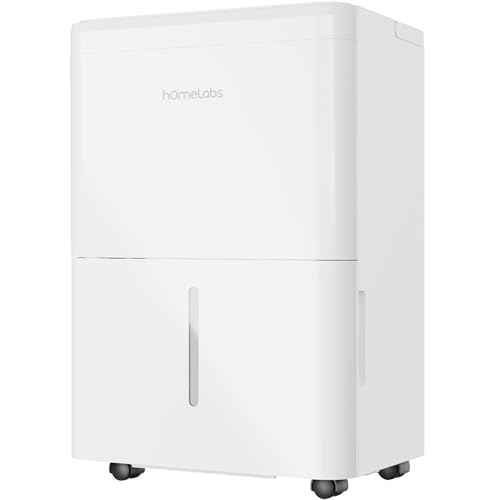
The smallest pick is a compact compressor unit built for one modest room. It removes 8 pints per day at standard room conditions, with a higher maximum in hot, saturated air, and the listing rates it for spaces up to 1,800 square feet, though its natural home is a single office, bedroom, or bathroom. The body is only 7.5 inches deep, 11 inches wide, and 16.1 inches tall at 22.3 pounds, so it fits under a side table or beside a bookshelf where a full-size unit cannot. It still includes the full smart package: Wi-Fi app control, Alexa and Google compatibility, adjustable humidity, a timer, auto defrost, auto shut-off, and a washable filter. hOmeLabs rates it at about 38 dB on the low setting, the quietest figure here. The 0.4 gallon tank is small, but a 3.3 foot drain hose is included for continuous drainage.
- Strength: The only pick that genuinely disappears into a small office, and the quietest on its low setting for call-heavy days.
- Strength: Full app and voice control at a compact size, with the drain hose included rather than sold separately.
- Trade-off: The 0.4 gallon tank fills quickly in humid weather if the hose is not connected.
- Trade-off: Eight pints a day cannot rescue a chronically wet basement office; it maintains a mildly damp room rather than drying a wet one.
Skip it if your office regularly sits above 65 percent humidity or shares air with a laundry area; move up to the 22 pint hOmeLabs or the Midea Cube.
Which One Fits Your Situation
A small closed-door office with mild dampness
Choose the hOmeLabs 8 Pint Wi-Fi. Its capacity matches a single room, its low fan setting is the quietest here, and its shallow body fits where a full-size unit would block a doorway or crowd a desk.
An office in a damp basement or open-plan floor
Choose the GoveeLife H7151 for raw capacity and drain flexibility, or the Midea Cube if the space is a single large room and you would rather empty a big bucket occasionally than run a hose. Both hold a set humidity automatically and report status to your phone.
A smart home already built on voice assistants and routines
Choose the GoveeLife for Alexa, Google Assistant, and IFTTT support, with the Midea Cube as the alternative if you prefer its tank design and only need Alexa or Google voice control.
Back-to-back video calls all day
Choose the Honeywell TP50AWKNR for its sleep mode, or the hOmeLabs 8 Pint for the lowest rated noise on low. Either way, schedule the heavy drying for early morning and evening so the unit idles while you talk.
No drain anywhere near the office
Choose the Midea Cube. The 3.2 gallon bucket runs far longer between empties than the other tanks here, and the app water-level reading warns you before a mid-week shutoff.
Common Mistakes
- Buying by coverage headline alone and putting a 50 pint unit in a 120 square foot office, where it short-cycles and adds noise without drying better.
- Running the fan on high during calls instead of scheduling heavy drying for before and after work hours.
- Ignoring the drain question until the first full-tank shutoff stops the unit in the middle of a humid week.
- Placing the unit flush against a wall or under a desk, which chokes the intake and cuts real performance.
- Setting the target humidity too low; 40 to 50 percent is the comfortable office range, and chasing 30 percent just runs the compressor longer.
- Forgetting the filter; a clogged washable filter quietly reduces airflow and moisture removal over a season.
- Assuming a smart plug can replace a smart dehumidifier; cutting power with a plug defeats the humidistat, and only models with auto restart resume properly, without app control or tank alerts.
FAQ
What humidity level should a home office dehumidifier hold?
Aim for 40 to 50 percent relative humidity. That range feels comfortable, discourages mold on paper and walls, and avoids the dry-air irritation that comes from pushing a room toward 30 percent. Every pick here lets you set a target in that range and hold it automatically.
Can a smart dehumidifier run during video calls?
Yes, with the right setup. Run the unit on its lowest fan speed or sleep mode during calls and schedule full-power drying for the hours before and after. The hOmeLabs 8 Pint is rated at about 38 dB on low, and placing any unit a few feet from the microphone makes more difference than the model alone.
Do these dehumidifiers need a special Wi-Fi network?
They pair over 2.4 GHz Wi-Fi, which nearly every home router provides alongside its 5 GHz band. If your router merges both bands under one name, pairing usually still works; if it fails, a temporary 2.4 GHz network name during setup solves it. After pairing, the apps work from anywhere, not just at home.
Is a drain hose better than emptying the bucket?
For an office, usually yes. A gravity hose to a floor drain or sink removes the main maintenance task and prevents full-tank shutoffs. A bucket is fine in mildly damp rooms, especially the Midea Cube’s 3.2 gallon tank, but in a humid climate any small tank becomes a daily chore without a hose.
What happens after a power outage?
All five models include auto restart, so they resume their previous settings when power returns instead of sitting idle until someone notices. The app-connected models also come back online automatically, which keeps schedules and alerts working after a brief outage.