Key takeaways
- A quiet deep craft table in five slow stages: loose titles first, adult frames second, a patient sort third, the wash fourth, dry color last.
A quiet deep craft table is the session a family settles into and forgets to hurry: pages spread wide, chairs pulled close, nobody watching the clock. Depth changes what a table can hold. A long, absorbed session can carry the slow stages first — the naming, the framing, the sorting — because there is time for each to finish properly. So the round is built for the pace it runs at. The letters come first, laid loose on blank pages, fixed only when each line reads true. The one heated tool belongs to an adult, second, while attention is calmest. The small pieces are sorted third, one box at a time. The wash runs fourth. And the color closes the round, laid down dry at the end, when every page already has its name waiting.
So the order runs titles, frames, pieces, wash, color. The Carson Dellosa letters come first, spread loose across the blank pages. The MIKA3D refills come second, in adult hands, drawing one raised frame inside the edge of each named page. The Mathtoxyz boxes come third, gathering every small piece home. The Kikkerland Dryer Buddies run fourth: a laundry product, one pick with one ASIN, carrying the wash-day reset while the makers rest. And the Kwik Stix close the session: solid tempera laid down dry beneath titles already waiting.
As an Amazon Associate, we earn from qualifying purchases.
Quick Answer
For a quiet deep craft table, lay the Carson Dellosa titles first, loose until each line reads true. Let an adult draw the MIKA3D frames second, slowly, one page at a time. Sort the Mathtoxyz pieces third, one latched box at a time. Run the Kikkerland wash-day reset fourth. Close with the Kwik Stix dry color, solid tempera under titles already waiting.
Carson Dellosa Black Cutout Letters: First, Titles Given All the Time They Need

The round opens with the words, and a deep session is exactly the right place for them, because naming done first gets the session’s freshest attention instead of its leftovers. The Carson Dellosa set takes the first turn: 219 black cutout letters, each 4 inch, tipped out gently while the pages still lie blank. Starting with titles sounds backwards until it is tried: a page that already knows its name tells its maker what belongs on it.
The letters are laid loose and fixed only when each line reads true. A maker arranges the letters along the top of the page, leans back, and reads the line aloud at the unhurried pace the room allows. A line that runs long sheds a word; a line that reads flat trades one, and anyone may argue for a swap, because nothing is fixed yet. Only when the line finally reads true are the letters set in place, and the spares slide flat back into their folder. With every page named, the round hands over to its one adult stage.
| Carson Dellosa | 219-Pc Black Cutout Letters 4 inch | B08QY9MG9Z | 219 pieces; 4 inch black cutout letters for names, titles and labels; already cut, so they are spread out, read from a step back, and rearranged by hand before anything is fixed; spares stack flat in one folder |
MIKA3D PLA Refills: Second, an Adult Frames Every Named Page Slowly
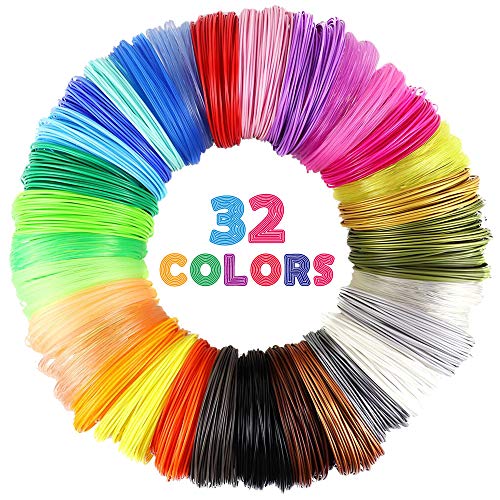
The second stage is not a children’s stage at all, and the settled middle of a deep session is exactly when it belongs: the makers lean back with their named pages, and the table belongs to one calm adult. The MIKA3D pack takes the second turn: PLA filament refills in 32 colors, refills only, with no pen in the box, so this round assumes a compatible 3D pen already lives in the house. The adult draws one raised border just inside the edges of each named page, letting each line of filament settle before the next begins.
A 3D pen is a heated tool, and a slow room never means a casual one. The pen is held by an adult, or by an older child under close adult supervision, with the free hand kept clear of the tip. Before any spool is opened, the filament type is read against the type the pen maker states for that pen, and the two must match exactly; if they do not, the pack stays closed and the pages go unframed. The pen rests only on a heat-safe surface when set down, and each framed page is left untouched until its border has cooled and set hard.
| MIKA3D | 32-Color 3D Pen PLA Refills | B07B6VY719 | PLA filament refills in 32 colours for a compatible 3D pen; refills only, pen not included; filament type checked against the pen maker’s stated type; a 3D pen is a heated tool, so adult handling or close adult supervision, with a heat-safe resting surface; stored closed on an adult shelf, out of reach |
Mathtoxyz Bead Organizers: Third, the Patient Sort in the Middle of the Day

The third stage turns the tidy-up into the session’s quiet centerpiece. In a deep session, small pieces have time to come out properly: beads for a border here, sequins for a sky there, tiny shapes waiting their turn in a shallow dish. The Mathtoxyz set takes the third turn: 14 latched boxes, each holding one family of small pieces, beads by color in one box, sequins in another, tiny shapes by size. Sorting third means the sort itself becomes part of the making — pieces are counted, compared, and chosen again with fresh eyes.
The rule here is the plainest one on the table: one box at a time, never all at once. Each family of pieces is gathered, tipped into its box, and the lid clicks latched before the next box opens. That discipline matters, because an open box spilled across a crowded table is a box lost. These are small parts, so the maker’s age guidance decides who joins this stage, and very young children stay well clear while any box stands open; older children who do help work piece by piece. When the last piece is placed, the boxes are stacked away latched and out of reach.
| Mathtoxyz | Bead Organizers 14pcs | B09VTLZ9NC | 14 latched organizer boxes for beads and other small craft pieces; colours and sizes stored separately; one box opened at a time with leftovers returned before the next opens; small parts: follow the maker’s age guidance and keep beads away from very young children; stored latched and out of reach |
Kikkerland Dryer Buddies: Fourth, the Wash-Day Reset While the Session Rests

The fourth stage steps away from the table, and a deep session is long enough to hold it without breaking stride. The Kikkerland Dryer Buddies are a laundry product for the tumble dryer, one pick with one ASIN, used exactly per the product directions. Their place in a kids-art round is the wash-day reset, and here it runs fourth: the gear goes through the drum at the session’s natural pause, so the makers return to aprons already clean.
The aprons and smocks come off their hooks carrying the morning on them: cuffs dusted from the first stages, a pocket gritty from some forgotten handful. They go into the drum with the Buddies, the door is pressed shut, and the dial is turned once. While the drum turns, the table rests too: framed pages stacked, boxes shelved, chairs pushed in. When the drum stops, the gear comes out clean and soft and goes back on its hooks, and the makers return to a room that feels reset rather than merely paused.
| Kikkerland | Dryer Buddies | B01M0PG970 | Laundry product for the tumble dryer; used exactly per the product directions; the wash-day reset that returns craft aprons and smocks clean and soft between sessions |
Kwik Stix Tempera Paint Sticks: Last, Dry Color Under Titles Already Waiting

The round closes with the color, saved for last because every page now carries its title and its frame, and coloring into a named, bordered page is the most absorbed work of the day. The Kwik Stix set takes the final turn: 24 tempera paint sticks, the paint held solid inside each stick, so a maker uncaps a color and draws it straight onto the page. There is no cup to fill, no brush to rinse, and nothing liquid standing anywhere on the table. Coloring last works because the pages know what they are: each maker fills the space under a title chosen first, and the color serves the name instead of searching for one.
The method suits the depth of the session. Each maker works the broad fields first, letting one color settle before the next joins it, then moves to the fine corners. Because a dry stick needs no washing between colors, sticks pass hand to hand without a pause, and each is capped the moment it finishes so the set never sprawls. The pages lift off and stack at once, dry, and the table ends the day holding only finished work: named, framed, and colored in full.
| Kwik Stix | Tempera Paint Sticks 24 | B01GNAVT0U | 24 tempera paint sticks for paper projects; solid paint in stick form, drawn straight onto the page, so no water cup, brushes or rinsing; finished pages lift off the table and stack at once; capped between uses; adult supervision for younger children, per the maker’s directions |
How to Choose
Choose by giving each stage the time a deep session offers. Set the Carson Dellosa titles first: 219 black letters at 4 inch, laid loose and fixed only when each line reads true. Draw the MIKA3D frames second: 32 colors, refills only, type matched to the pen maker’s stated type, an adult guiding the heated pen. Sort the Mathtoxyz pieces third: 14 latched boxes opened one at a time, small parts governed by the maker’s age guidance. Run the Kikkerland reset fourth: a laundry product used per its directions, one pick with one ASIN. Lay the Kwik Stix color last: 24 solid tempera sticks, no water cup and no rinsing, capped between uses.
Who Should Skip
Skip the cutout letters if titles are always handwritten, or if your makers would rather discover a page’s name at the end. Skip the refills if there is no compatible 3D pen in the house, or if no adult can give the framing stage calm attention. Skip the bead organizers if nobody decorates with small pieces, or if very young children cannot be kept clear while boxes are open. Skip the Buddies if you line-dry. Skip the paint sticks if your family prefers brushes and wet washes, or if your sessions are short ones with no room for a closing stage.
FAQ
Why do the titles come first here?
Because a deep session can afford it. The big black letters are laid loose on blank pages, read aloud from a lean-back, and fixed only when each line reads true, so every page starts already knowing its name.
Why does an adult take the second stage?
Because a 3D pen is a heated tool. An adult, or an older child under close adult supervision, draws each raised frame slowly, with the filament type checked against the pen maker’s stated type first.
Why does the wash run in the middle of the session?
Because the reset fits the pause. The aprons and smocks go through the drum while the table rests, so the gear comes out clean and the final stage starts with nothing left over.
Why is the color saved for last?
Because the pages are ready for it. With titles fixed and frames set, the solid tempera goes down dry under a name already waiting, with no water cup and no rinsing on the table.
Final Verdict
A quiet deep table is made by giving each stage its full share of an unhurried day. The Carson Dellosa letters run first: 219 black letters at 4 inch, laid loose and fixed only when each line reads true. The MIKA3D refills run second: 32 colors, refills only, type checked against the pen maker’s stated type, an adult drawing one raised frame inside each named page. The Mathtoxyz organizers run third: 14 latched boxes opened one at a time under the maker’s age guidance. The Kikkerland Dryer Buddies run fourth: a laundry product, one pick with one ASIN, sending the gear through the wash at the session’s pause. And the Kwik Stix close the day: 24 tempera sticks laying dry color down solid, no water cup and no rinsing, under titles that were waiting all along.
Product and ASIN Reference
| Product | ASIN |
|---|---|
| Carson Dellosa 219-Pc Black Cutout Letters 4 inch | B08QY9MG9Z |
| MIKA3D 32-Color 3D Pen PLA Refills | B07B6VY719 |
| Mathtoxyz Bead Organizers 14pcs | B09VTLZ9NC |
| Kikkerland Dryer Buddies | B01M0PG970 |
| Kwik Stix Tempera Paint Sticks 24 | B01GNAVT0U |