Key takeaways
- Mild golden craft tables in five warm stages: the dryer reset first, solid color second, loose titles third, calm frames fourth, the gentle sort last.
A mild golden table is one set in the warm end of the afternoon, when the light comes in low and amber and everything on the surface looks softer than it did at noon. The reset goes first, the week’s smocks sent off early so the room begins clean. The color goes second, laid down while the golden light is at its best. The titles go third, black letters settled over pages that are already dry. The frames go fourth, traced slowly around the finished work. And the sort closes the round, small pieces gathered home as the light thins out.
The order follows the light. The reset leads because a chore started first finishes without being watched. Color comes second because golden light flatters every wash laid under it, and the pages dry while the room is still bright. Titles come third because naming a finished page is calm work for the middle of the session. Frames come fourth because a heated tool wants an unhurried room. The sort waits until last because counting small pieces into boxes is the gentlest way to end.
As an Amazon Associate, we earn from qualifying purchases.
Quick Answer
For a mild golden weekend craft table, send the Kikkerland dryer reset off first, lay the Kwik Stix color second in the best of the light, set the Carson Dellosa titles third over the dry pages, trace the MIKA3D frames fourth, and close with the Mathtoxyz sort as the light thins.
Kikkerland Dryer Buddies: First, the Reset Sent Off Before the Light Turns

The reset leads this round, and it is named plainly before anything else is said: the Kikkerland Dryer Buddies are a laundry product for the tumble dryer, one pick with one ASIN, used exactly per the product directions. Their place in a kids-art round is the wash-day reset, the quiet chore that keeps the craft smocks ready, and sending it off first means the machine works in another room while the session unfolds at the table.
The smocks come down from their hooks carrying the week in their fabric: dried glue at the cuffs, a wash of old paint across one front, chalk dust ground into a pocket. They go into the drum with the Buddies, the door is pressed shut, and the dial is turned once. That is the entire task. Nobody stands over a sink, soaks a sleeve, or scrubs at a stain; the machine keeps its own time behind the laundry room door. When the cycle ends, the smocks are shaken out in the last of the light, smoothed flat, and hung back on their hooks, clean and soft for the next session.
| Kikkerland | Dryer Buddies | B01M0PG970 | Laundry product for the tumble dryer; used exactly per the product directions; the wash-day reset that returns craft aprons and smocks clean and soft between sessions |
Kwik Stix Tempera Paint Sticks: Second, Color Laid Down in the Best of the Light

The color runs second because golden light is the finest light to paint under, and a mild table makes the most of it while it lasts. The Kwik Stix set comes out: 24 tempera paint sticks, the paint held in solid form inside each stick, so color travels from the stick straight onto the page and stops there. Caps come off one at a time, and each maker settles in: a band of warm sky across the top of the page, a sunlit field beneath it, each stroke drawn at an easy pace so the color lies smooth and even.
The ease of this stage comes from everything that never interrupts it. There is no water cup to fetch, no brush waiting to be rinsed between colors, and no row of open jars to mind when a page is finished. Because the paint is solid, a completed page can be lifted the moment its last stroke lands and carried to the drying row. Each stick is capped as its color comes to rest, and the pages dry in a golden line along the windowsill while the room stays mild and unhurried.
| Kwik Stix | Tempera Paint Sticks 24 | B01GNAVT0U | 24 tempera paint sticks for paper projects; solid paint in stick form, drawn straight onto the page, so no water cup, brushes or rinsing; finished pages lift off the table and stack at once; capped between uses; adult supervision for younger children, per the maker’s directions |
Carson Dellosa Black Cutout Letters: Third, Titles Settled Over Dry Pages

The titles run third because naming a finished page is settled work, and the middle of a golden session is the right moment for it. Each page is already colored and dry, so its maker can read it whole before choosing a word. The Carson Dellosa set comes out: 219 black cutout letters, each 4 inch, already cut, so the stage is pure arranging with no scissors and no trimming. Against the warm colors, the black letters sit bold and plain, a clear caption resting over every picture.
Each maker takes a finished page and spells its title along the top edge, one letter at a time, with everything left loose. The letters are laid loose and fixed only when each line reads true. A title that runs long is lifted, shortened, and read again from across the table, where a cramped gap shows plainly. A letter that leans is nudged upright rather than pressed down at an angle. Only when the whole line sounds right read aloud is anything fixed. The spare letters slide back into their folder and stack flat, and the table holds a row of named pages waiting for their frames.
| Carson Dellosa | 219-Pc Black Cutout Letters 4 inch | B08QY9MG9Z | 219 pieces; 4 inch black cutout letters for names, titles and labels; already cut, so they are spread out, read from a step back, and rearranged by hand before anything is fixed; spares stack flat in one folder |
MIKA3D PLA Refills: Fourth, Frames Traced Slowly Around Finished Work
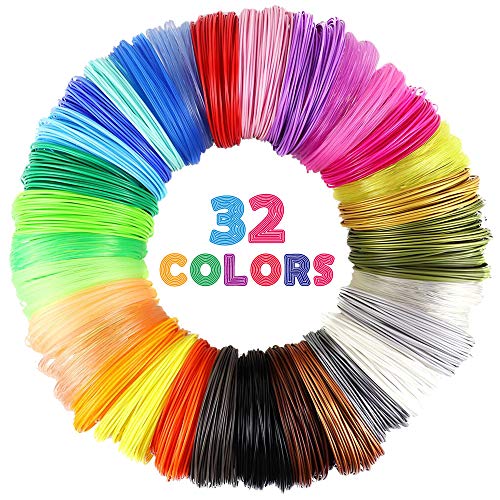
The frames run fourth because they belong in the unhurried stretch of the session, when the painting is done, the titles are fixed, and nobody is waiting on anything. A raised border traced now edges each finished page, drawn carefully around work that is already complete. The MIKA3D pack comes out: PLA filament refills in 32 colors. They are refills only; no pen arrives in the box, so this stage assumes a compatible pen already lives in the house.
A 3D pen is a heated tool, and that fact governs the whole stage. The pen is handled by an adult from the moment it warms up, or by an older child under close adult supervision, with the free hand kept well away from the tip. Before a single spool is opened, the filament type printed on the refill pack is read against the type the pen maker states for that pen, and the two must match exactly; if they disagree, the pack stays closed and the pages go unframed. With the match confirmed, a warm color is chosen, and the adult draws a single raised line just inside each page edge, moving slowly so every border rises evenly. The pen rests only on a heat-safe surface when set down, and each framed page is left alone until its border has cooled and set hard. The pack is then stored closed on an adult shelf, out of reach.
| MIKA3D | 32-Color 3D Pen PLA Refills | B07B6VY719 | PLA filament refills in 32 colours for a compatible 3D pen; refills only, pen not included; filament type checked against the pen maker’s stated type; a 3D pen is a heated tool, so adult handling or close adult supervision, with a heat-safe resting surface; stored closed on an adult shelf, out of reach |
Mathtoxyz Bead Organizers: Last, the Sort That Gathers the Day Home

The sort closes this round because it is the gentlest work on the table, and a golden afternoon should end with its softest job. The Mathtoxyz set comes out: 14 latched boxes, each a small home for a different kind of piece. Beads left over from an earlier project, buttons set aside mid-pattern, tiny shapes with no page yet — all are gathered one at a time, named as they are picked up, and settled into the box that suits them.
These are small parts, so the maker’s age guidance decides who may take part, and very young children stay well clear of the table while any box stands open. The rhythm is unhurried by design: one box open at a time, its pieces counted in slowly, its latch clicked shut before the next lid is lifted. Nothing is left loose, where a rolling bead could wander off the table edge and be lost in the fading light. When the last box closes, the boxes are stacked away latched and out of reach, and the table stands clear as the day ends.
| Mathtoxyz | Bead Organizers 14pcs | B09VTLZ9NC | 14 latched organizer boxes for beads and other small craft pieces; colours and sizes stored separately; one box opened at a time with leftovers returned before the next opens; small parts: follow the maker’s age guidance and keep beads away from very young children; stored latched and out of reach |
How to Choose
Choose by the stage where your table spends its golden hours. Send the Kikkerland reset off first: a laundry product used exactly per its directions, working in another room all session. Lay the Kwik Stix color second: 24 solid tempera sticks, no water cup and no rinsing, each page lifted dry at once. Set the Carson Dellosa titles third: 219 black letters at 4 inch, spread loose over dry pages and fixed only when each line reads true. Trace the MIKA3D frames fourth: 32 colors, refills only, the filament type matched to the pen maker’s stated type, an adult at the heated pen. Run the Mathtoxyz sort last: 14 latched boxes, one open at a time, small parts governed by the maker’s age guidance and stored latched and out of reach.
Who Should Skip
Skip the Dryer Buddies if the household line-dries. Skip the paint sticks if your family prefers brushes and wet washes. Skip the cutout letters if titles are always handwritten, or if younger makers would rather name a page before they paint it. Skip the refills if there is no compatible 3D pen in the house, or if no adult can give the heated stage unhurried attention. Skip the bead organizers if nobody works with small pieces, or if very young children cannot be kept clear while boxes stand open.
FAQ
Why does the reset come first this time?
Because a chore started first finishes without being watched. The dryer needs no hands once started, so the smocks come back clean while the whole session happens at the table.
Why is the color laid down so early?
Because golden light is the finest light to paint under. The sticks go down while the room is at its warmest and brightest, and the pages dry along the windowsill in that light.
Why do the titles come before the frames?
Because a dry, colored page can be read whole before it is named, and the letters are easier to arrange on a flat page. Once each line reads true and is fixed, the raised frame is drawn around the finished work.
Why does the sort close the round?
Because it is the softest work on the table. Counting small pieces into latched boxes asks for slow hands and a clear surface, and it leaves the table tidy as the light thins out.
Final Verdict
A mild golden table is judged by whether it uses its warm hours well, and this one does from the first minute to the last. The Kikkerland Dryer Buddies run first: a laundry product, one pick with one ASIN, resetting the smocks on its own in another room. The Kwik Stix run second: 24 tempera sticks laying warm color with no water cup and no rinsing, each page lifted dry at once. The Carson Dellosa letters run third: 219 black letters at 4 inch, laid loose over the finished pages and fixed only when each line reads true. The MIKA3D refills run fourth: 32 colors, refills only, type checked against the pen maker’s stated type, an adult tracing slow borders around complete work. The Mathtoxyz organizers close the round: 14 latched boxes counting every small piece home, stored out of reach as the light fades.
Product and ASIN Reference
| Product | ASIN |
|---|---|
| Kikkerland Dryer Buddies | B01M0PG970 |
| Kwik Stix Tempera Paint Sticks 24 | B01GNAVT0U |
| Carson Dellosa 219-Pc Black Cutout Letters 4 inch | B08QY9MG9Z |
| MIKA3D 32-Color 3D Pen PLA Refills | B07B6VY719 |
| Mathtoxyz Bead Organizers 14pcs | B09VTLZ9NC |