Key takeaways
- Budget tier: a mechanical solution, such as a secondary sliding-door security bar or a keyed foot lock, plus a keypad on a different door. This is not a keypad on the slider itself, but it improves security without electronics.
- Mid-range tier: a frame-mounted keypad accessory or a door-maker lock aimed at your specific door series, subject to compatibility with your frame.
- Premium tier: products like the Lockly Guard slide edition with fingerprint, app control and a Wi-Fi hub, or a professionally installed multi-point or mortise upgrade from the door manufacturer.
The honest answer for a true sliding glass door is that very few keypad locks are made for it: the Lockly Guard slide edition (sold under the Athena name) is the one product line from this research that the maker describes as built for sliding doors, while the keypad deadbolts most people think of (Yale, Kwikset, Schlage, Ultraloq) are made for hinged doors and will not simply bolt onto a sliding panel. This guide explains what “keypad sliding door lock” means in practice, which products are genuine fits, which are commonly mistaken for fits, and what to do if nothing suits your door.
A sliding patio door has a narrow aluminium, vinyl or wood stile, a hook or mortise latch built into the panel and a frame that varies by manufacturer. A standard keypad deadbolt needs a round hole drilled through a door slab and a bolt that enters a strike in a jamb. A sliding stile usually has neither the room nor the geometry. That is why a purpose-built product or a frame-mounted accessory is needed.
Our top picks


As an Amazon Associate we earn from qualifying purchases at no extra cost to you.
At a Glance: What Actually Fits a Sliding Door
| Product | Door type | Key stated details | Limits |
|---|---|---|---|
| Lockly Guard, slide edition (PGD228FSL / PGD228WSL) | Sliding doors | The maker’s spec sheet lists a door thickness of 35 to 65 mm (about 1-3/8 to 2-9/16 inches), a frame width of about 2 to 3 inches and a 30 mm slide backset; PIN Genie keypad, fingerprint, smartphone control; optional Secure Link Wi-Fi hub | Retailer listings give different thickness ranges, so rely on the maker’s guide; frames vary, and retailers note advanced DIY skill or professional installation is needed |
| Standard keypad deadbolts (Ultraloq U-Bolt, Kwikset, Schlage, Yale Assure Lock 2) | Hinged doors | 2-1/8 inch bore, 1 inch edge hole, 1-3/8 to 1-3/4 inch door thickness for the U-Bolt | Not designed for sliding doors; Ultraloq states its Bolt Fingerprint is not meant for glass or sliding doors |
The Realistic Options
Lockly Guard, slide edition
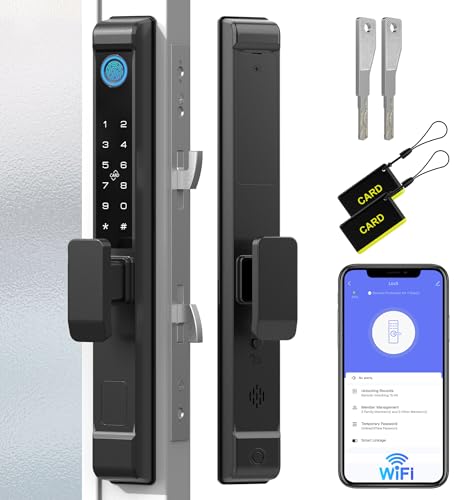
The Lockly Guard family includes a Slide Edition under the Athena name (listed as PGD228FSL and PGD228WSL), a mortise or swing edition (PGD228FSW and PGD228WSW), and other variants called Latch, Duo and Defender. Lockly describes Guard as made for existing and new sliding and swing-style doors, mounts on the door frame and avoids drilling through glass. Entry options listed by the maker include a randomised-digit keypad (PIN Genie), fingerprint, a key override and a smartphone app, and an optional Secure Link Wi-Fi hub adds remote control and voice assistant integration. Finishes listed include chrome, satin nickel and matte black.
The PIN Genie keypad shows digits in shuffled positions across a small set of buttons and you press any button containing the next digit of your code. The idea is to make smudge or over-the-shoulder observation harder. It also takes a little practice, and anyone sharing the door with children or older relatives should try it before committing.
The maker’s spec sheet and installation guide list a door thickness of 35 to 65 mm (roughly 1-3/8 to 2-9/16 inches), a door frame width of about 2 to 3 inches and a slide backset of about 30 mm, with different spindle and screw sizes depending on thickness. A few retailer listings show narrower ranges, so measure your door and read the Slide Edition installation guide before buying. Lockly says door frames differ and suggests a professional or a DIYer comfortable with this type of job.
Why a standard keypad deadbolt is the wrong answer
Ultraloq’s U-Bolt series needs a 2-1/8 inch bore and a 1 inch latch hole and is rated for doors 1-3/8 to 1-3/4 inches thick. Those are swing-door measurements. Ultraloq also states that its related Bolt Fingerprint is not designed for glass or sliding doors and not made for mortise or multi-point locks. The same logic applies to other swing-door deadbolts: using one on a sliding door is outside what the makers describe.
Door-maker accessories and hinged patio doors
Some patio door manufacturers offer their own keypad or electronic hardware matched to their frames, and a few third-party locks were made for specific brands of hinged or folding patio doors. Availability changes and some of these have become hard to find, so ask the door manufacturer or an authorized dealer what is currently supported for your exact door series and build date. A hinged patio door with a standard bore can use an ordinary keypad deadbolt.
Budget, Mid-Range and Premium Tiers
- Budget tier: a mechanical solution, such as a secondary sliding-door security bar or a keyed foot lock, plus a keypad on a different door. This is not a keypad on the slider itself, but it improves security without electronics.
- Mid-range tier: a frame-mounted keypad accessory or a door-maker lock aimed at your specific door series, subject to compatibility with your frame.
- Premium tier: products like the Lockly Guard slide edition with fingerprint, app control and a Wi-Fi hub, or a professionally installed multi-point or mortise upgrade from the door manufacturer.
Pick X If…
| If your door is… | Look at | Notes |
|---|---|---|
| A standard aluminium, vinyl or wood slider | Lockly Guard slide edition | Confirm frame and stile fit against the installation manual |
| A hinged or folding patio door from a major maker | The door maker’s own hardware list | Ask the maker which electronic locks suit your series and build date |
| A slider where you cannot find a compatible keypad | Mechanical secondary lock and a keypad on another entry | Ask the door manufacturer about an upgrade path |
| A hinged patio door | A standard keypad deadbolt | Check bore, backset and thickness |
Fit and Compatibility Notes
- Identify the door type. Sliding, hinged and folding patio doors look similar from outside but need different hardware.
- Identify the manufacturer. Many patio door makers publish accessory lists. If you can read the maker’s name on the frame or glass spacer, start there.
- Measure the stile width and thickness. A narrow stile may not leave room for a mounted keypad body.
- Look at the existing latch. Hook latches, mortise latches and multi-point systems each behave differently, so check the product’s latch requirements.
- Do not drill glass or tempered panels. Frame-mounted designs exist precisely to avoid this.
Safety Notes
- A patio door is often an escape route. Any lock you add must be operable from inside without a key, special knowledge or a code, in line with the maker’s instructions and local building code.
- If a product asks for mains wiring, follow the manual and local code and use a licensed electrician. The battery-powered products here do not need that.
- Do not remove or defeat the original latch. A keypad accessory is an addition to a working latch, not a replacement for a damaged one.
- Replace batteries on the warning, and keep a mechanical key somewhere safe if the product supplies one.
- No lock prevents break-ins by itself, and glass remains glass. Treat a keypad as convenience plus a latch, not as a guarantee.
Alternatives to a Keypad on the Slider
- Security bar or dowel in the track. A simple mechanical stop that needs no batteries.
- Keyed secondary lock. Often mounts on the frame without touching the glass.
- A door sensor. Not a lock, but it tells you when the slider opens.
- Replace the door. Newer patio doors from major makers offer multi-point and electronic locking options designed together with the frame.
Frequently Asked Questions
Can I put a normal keypad deadbolt on a sliding door?
Generally no. Standard deadbolts need a bored hole in a door slab and a jamb strike, and sliding stiles usually cannot accept either. Ultraloq explicitly says one of its models is not designed for glass or sliding doors.
What is the Lockly Guard slide edition?
It is the sliding-door variant of Lockly’s Guard line, listed as PGD228FSL and PGD228WSL. The maker describes it as mounting on the door frame and offering keypad, fingerprint, key and phone entry.
Do I need an electrician?
Not for the battery-powered products described here. If any product you consider requires wiring into house circuits, follow its manual and local code and use a licensed electrician.
Is a keypad on a sliding door as secure as one on a front door?
The two cannot be compared directly. The lock mechanism, frame, glass and track all affect how the door resists force, and makers do not claim a keypad makes a slider secure by itself.
Will the lock work during a power outage?
Battery-powered models keep working on battery. Wi-Fi hubs and apps depend on your network and power, but the keypad itself does not. Check the manual for the manual override method.
What if my door is not on any compatibility list?
Contact the door manufacturer, ask a locksmith to measure the stile and latch, and consider a mechanical secondary lock. Forcing an ill-fitting product onto a door can damage the frame and void warranties.