Key takeaways
- Want the best rugs to protect hardwood floors? Learn which backings scratch or stain wood, and compare felt-and-rubber pads and rug systems that protect it.
Disclosure: As an Amazon Associate, this site may earn from qualifying purchases made through links in this article, at no additional cost to you.

A rug protects a hardwood floor only as well as the layer that actually touches the wood. That is the uncomfortable truth behind this category. A beautiful rug with a coarse jute back can sand a floor’s finish with every footstep, because grit gets trapped underneath and the backing grinds it in. A cheap vinyl or PVC-backed rug can do worse, reacting with common floor finishes and leaving a discoloured ghost of itself behind. Latex coatings can dry out, crumble and stain. The rug is the visible half of the system; the protective half is the pad beneath it, or a pad built into the rug’s own design.
So this guide is organised around protection first. It explains which materials are safe on finished wood, then compares the felt-and-natural-rubber pads and the two-part rug system that do this job properly. If you already own a rug you love, a pad is almost certainly your answer. If you are starting from bare boards, the rug system below builds the protection in.
What actually protects hardwood
Felt plus natural rubber is the standard answer
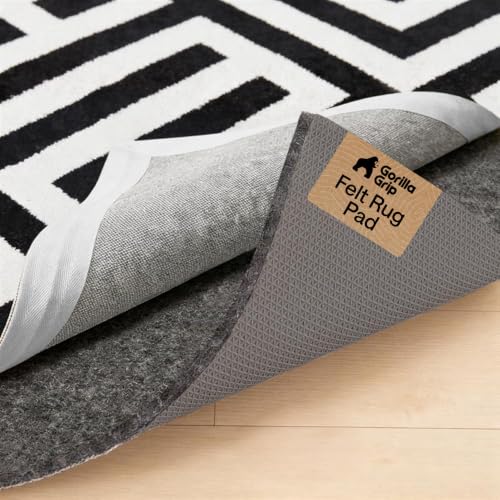
The pad construction that flooring professionals reach for combines a dense felt body with a natural rubber backing. The felt cushions the rug, spreads the load of furniture legs and stops the rug’s own backing from ever grinding against the finish. The natural rubber underside grips the floor so the rug cannot creep — movement is what turns trapped grit into scratches — and natural rubber, unlike PVC or vinyl plastic, does not react with standard polyurethane finishes. Look for pads described as safe for hardwood, and avoid anything with a plasticised vinyl layer or an adhesive coating meant to be stuck down.
Thickness is a trade-off, not a virtue
Pads come in two working thicknesses. Around an eighth of an inch keeps a low profile under doors and suits most rugs. Around a quarter of an inch adds real cushion under thin flat-weave rugs and in rooms where furniture weight concentrates, but it raises the rug enough to catch a door with tight clearance and can make edges a trip line in hallways. Match the pad to the rug: a thick plush rug needs only the thin pad; a thin vintage flat-weave wants the thicker one.
Size and trimming
A pad should sit about an inch inside the rug’s edge on all sides, so it stays invisible and the rug’s edge lies flat on the floor. Buy the pad size at or just above your rug size and trim it with household scissors — felt-and-rubber pads cut cleanly. An oversized pad that peeks out looks untidy and collects dust; an undersized one lets the rug’s edges slide.
Habits that matter as much as the pad
Vacuum under the rug a few times a year and sweep up the grit that migrates there; the pad stops the rug moving, but trapped grit is still abrasive. Lift, do not drag, furniture across a rug. Check the pad yearly: natural rubber ages gracefully, but a pad that has gone stiff or crumbly should be replaced before it marks the floor.
The picks
Gorilla Grip Felt and Natural Rubber Rug Pad, 5×8 (ASIN: B07TDN5C6Y) — the default choice
Gorilla Grip’s felt-and-rubber pad is the most widely used answer to this exact problem. The body is condensed needle-punch felt — dense rather than lofty, so it cushions without feeling spongy — bonded to a natural rubber backing that holds the rug still on smooth boards. The 5×8 size in the eighth-inch thickness suits the majority of living-room and bedroom rugs; the same pad is made in sizes from small mats up to room-scale pieces, and in a quarter-inch thickness for thin rugs that need more body.
It trims easily to sit inside your rug’s footprint, works under rugs on hardwood, tile and laminate alike, and the felt is made with recycled content. If you have a rug, hard floors and no pad, this is the purchase that closes the gap.
BAGAIL Felt and Natural Rubber Backing Rug Pad, 4×6 (ASIN: B0DFV96QDP) — dense felt, strong grip
BAGAIL’s pad follows the same proven recipe — dense felt cushioning over a natural rubber backing — in a 4×6 size that suits smaller rugs, entryways and the space under a desk or dining set for four. The felt is tightly packed, which keeps the pad’s profile low and its surface even, and the rubber underside grips firmly enough for high-traffic spots where rugs tend to travel.
Like the Gorilla Grip, it cuts to size with scissors and sits hidden an inch inside the rug edge. Choose it for small-to-medium rugs, for runners in hard-working hallways, or wherever the priority is grip and floor protection in a compact footprint.
Ruggable Kamran Rug with Standard Pad, 2×3 (ASIN: B09HXM7KKD) — the rug with protection built in
Ruggable takes the other route: the rug and pad are designed as one two-part system. The decorative top layer — here the Kamran design in royal blue, a vintage-look pattern — clings to a separate non-slip pad made for hard floors, and the top layer alone goes in the washing machine when it gets dirty. For a small rug by a sink, door or bed, that washability is the point, and the pad underneath is engineered for hard surfaces rather than adapted to them.
Two cautions belong with this pick. First, the 2×3 size is a mat, not a room rug — the system scales to larger sizes, but check the exact size and pad combination on the product page. Second, stock records for this particular size have been inconsistent, so confirm the listing shows the 2×3 with the Standard Pad as orderable before you buy. If it is unavailable, either pad above under your existing rug achieves the same floor protection.
Backings to avoid on finished wood
Some rugs should never sit directly on hardwood, whatever their price. Coarse jute and sisal backs are abrasive by nature; every shift of the rug works the fibres against the finish, and the wear pattern appears exactly where the rug sat. Vinyl and PVC backings are the quiet risk: the plasticisers that keep them flexible can migrate into polyurethane finishes and leave a permanent shadow or a tacky patch. Sprayed latex coatings are mixed — fresh, high-quality latex is generally well behaved, but cheap latex dries, powders and can bond lightly to the floor over years, lifting finish when the rug is finally moved. Adhesive gripper sheets and tapes belong on tile, not on wood you care about. If a rug you own has any of these backs, a felt-and-rubber pad converts it from a liability into a safe rug — which is why the pad, not the rug hunt, is most people’s correct first move.
Room by room
- Living room. The largest rug, the heaviest furniture, the most traffic. A pad here earns its keep twice over: it stops the creep that bunches rugs against sofa legs, and its felt spreads point loads from furniture feet that would otherwise dent through a thin rug into the boards. The eighth-inch Gorilla Grip suits most; go thicker under a flat-weave.
- Hallways and entryways. Runners travel more than any other rug because every step pushes the same direction. Grip matters most here, and a dense, low pad like the BAGAIL keeps the runner planted without raising a trip edge at doorways.
- Dining rooms. Chairs sliding in and out drag rugs sideways all week. A full-coverage pad, trimmed close to the rug’s edge, keeps the rug square under the table; check that chair legs still glide rather than catch the rug’s border.
- Bedrooms. The gentle case: traffic is barefoot and furniture is static. A thin pad is plenty, and its main job is the quiet one — keeping the rug’s backing off the finish for the years it will sit there.
Sunlight, rotation and the outline problem
A rug left in one position for years creates two outlines: the rug fades at its own pace, and the floor beneath it is shielded from the light that ages the surrounding boards, so the day the rug moves, a pale rectangle announces where it sat. No pad prevents that — it is light, not friction — but two habits soften it. Rotate the rug a half-turn every season or so if its pattern allows, which evens both its own wear and the light its edges receive, and when you redecorate, expect the covered patch to blend back gradually rather than instantly. While the rug is up for rotation is also the moment to vacuum the pad itself and check its rubber side: it should still feel supple and grippy. A pad that has hardened, cracked or started to smell of old rubber has done its service and should be replaced before it can mark the floor it was bought to protect.
Putting it together
- You already own a rug: buy a felt-and-natural-rubber pad — the Gorilla Grip for standard and large rugs, the BAGAIL for smaller footprints — and trim it an inch inside the rug’s edge.
- Your rug is thin and the room is busy: step up to a quarter-inch pad thickness for cushion and stability, checking door clearance first.
- You are starting from bare floor in a small, spill-prone spot: the Ruggable system builds the pad in and adds machine washing.
- Your rug has a jute, latex or vinyl back: a pad is not optional. It is the only thing standing between that backing and your finish.
- You are protecting a newly refinished floor: wait until the finish has fully cured before any rug goes down — fresh polyurethane needs weeks, not days, and even the gentlest pad can imprint a finish that is still soft underneath.
Hardwood survives decades of use when the layer touching it is soft, stable and chemically quiet.. Choose the pad or system that matches your rug and room, keep the grit vacuumed out from underneath, replace the pad when its rubber finally ages, and the floor under your rug will look the same as the floor around it — which is exactly the point of buying protection in the first place, and the quiet reward for choosing it well.