Key takeaways
- Two verified compact pellet stoves for home renovation projects, compared by footprint, hopper size, heating area and controls.
Disclosure: As an Amazon Associate, we earn from qualifying purchases.
Our top pick: Castle Serenity 12327. Runner-up: Cleveland Iron Works PS20W Mini Pellet Stove.
A pellet stove added during a home renovation has to earn its place twice over. It must heat the renovated space properly, and it must fit the room the renovation actually produced, which often means a smaller hearth area, tighter clearances and less floor space than a stove installed in a purpose-built setting. Compact pellet stoves exist for exactly this situation, but the genuinely compact end of the market is narrower than it first appears: many models sold as small are simply standard stoves with modest hoppers, and several well-known compact candidates could not be verified against a trustworthy Amazon US listing. This guide covers the two compact pellet stoves that could be verified, rather than padding the list with full-size models or with products whose listings conflict.
Both stoves below are freestanding pellet stoves with automatic ignition and modest footprints. They differ in hopper size, heating area and controls, and those differences are what should drive the choice for a renovation project.
Renovation changes the heating calculation in ways that are easy to miss. The stove is rarely replacing an identical stove in an identical room: the old open fireplace may be gone, the room may have been extended, knocked through or re-insulated, and the floor plan the stove has to serve may be new. A compact stove suits that moment because it can be positioned where the new layout wants it, rather than where the old heating appliance happened to stand, and because its smaller body leaves more of the renovated floor usable. The sections below look at each stove on the points that matter for that kind of project: how much floor it takes, how much space it can heat, how often it needs feeding, and how its controls behave in a modernised room.
Quick Picks
- Castle Serenity 12327 — Best overall compact pick: a 40 lb hopper and heating for up to 1,500 sq ft in a footprint of 18.25 x 23.75 inches, with a smart controller and Eco mode.
- Cleveland Iron Works PS20W Mini Pellet Stove — Best for the smallest spaces: the narrower body of the two, with WiFi control and heating sized for 800 to 1,200 sq ft.
Castle Serenity 12327
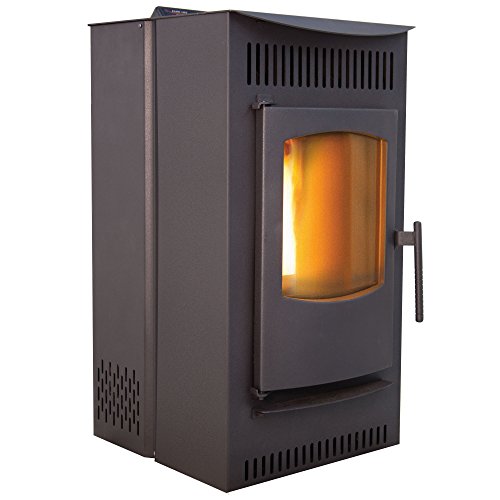
OUR TOP PICK
The Castle Serenity 12327 is the stronger all-round compact stove in this guide, and the one to start with for most renovation projects. Its footprint is 18.25 inches wide by 23.75 inches deep, as stated on the listing, which is small enough to sit on a modest hearth pad in a renovated living room, kitchen extension or converted outbuilding without dominating the floor plan. Within that compact body it carries a 40 lb hopper, the larger of the two hoppers in this guide, so refills are less frequent than the stove’s size might suggest.
The heating figure recorded from the listing is up to 1,500 sq ft, which covers the main living space of many renovated homes and puts the Serenity ahead of the smaller PS20W below for open-plan layouts. Heat output is only part of the story during a renovation, though. A newly insulated room holds heat differently from the draughty space it replaced, and a stove that can turn itself down matters as much as one that can work hard. The Serenity’s smart controller includes an Eco mode, which lets the stove moderate its output rather than cycling between full heat and off, and its automatic ignition means the stove can light itself on demand instead of needing to be lit by hand each time the room cools.
For a renovation, the practical appeal is the combination: a genuinely small footprint, a hopper that does not need daily attention in mild weather, and controls that suit a modernised, well-sealed room. Measure the intended hearth position carefully before ordering, including the clearances the manufacturer requires to walls and furniture, because a compact stove still needs its full clearance zone even though the body itself is small. The dimensions above are the stove body only, not the installed footprint with clearances and venting allowed for.
The 40 lb hopper deserves a moment of its own, because hopper size is where compact stoves usually compromise hardest. A small body leaves little room for fuel storage, and many compact models accept frequent refilling as the price of their size. The Serenity’s 40 lb capacity is generous for a stove of this footprint, and in a renovated home that matters twice: the stove can run through a cold evening and the following morning on one fill, and the household is not tied to a daily routine of topping up before the fire dies. Paired with automatic ignition, that makes the Serenity the easier of the two to live with as a main heat source for the space it serves, rather than as an occasional feature fire.
It is also worth saying what the Serenity is not. It is not a whole-house heating system, and its up-to figure of 1,500 sq ft assumes the heat can circulate through the space it serves. In a renovated open-plan layout that is a reasonable assumption; in a warren of small closed rooms it is not, and the stove will heat the room it stands in far better than the rooms beyond closed doors. Plan its position for the space it will actually warm, ideally where air can move through the main living area, and treat distant bedrooms as a separate heating question.
Specs
– Model: Castle Serenity 12327
– Footprint: 18.25 in W x 23.75 in D, as stated on the listing
– Hopper capacity: 40 lb, as stated on the listing
– Heating area: up to 1,500 sq ft, as stated on the listing
– Controls: smart controller with Eco mode, as stated on the listing
– Ignition: automatic, as stated on the listing
Pros
– Largest hopper in this guide at 40 lb, in the joint-smallest class of footprint
– Heats up to 1,500 sq ft, enough for open-plan renovated spaces
– Smart controller with Eco mode for well-insulated rooms that need gentle, moderated heat
– Automatic ignition for light-on-demand operation
Cons
– Wider and deeper than the PS20W, so it is not the pick for the very tightest hearth positions
– No WiFi control recorded from the listing checked for this guide
Cleveland Iron Works PS20W Mini Pellet Stove
The Cleveland Iron Works PS20W Mini Pellet Stove is the runner-up, and the pick when the renovated space is smaller or the hearth position is tighter. As recorded from the listing information available, it measures 20.55 inches deep by 18.23 inches wide by 32 inches high, so its width is a fraction narrower than the Serenity and its overall presence in the room is that of a deliberately mini stove. It is sized for 800 to 1,200 sq ft of heating, with an output figure of around 28,423 BTU recorded from the same source, which suits a single renovated room, a small open-plan area or a compact home rather than a whole large floor.
The hopper is recorded at 24 lb, with a note that some listings describe 18 lb for the PS20W-CIW variant, so confirm the exact variant and hopper figure on the product page before ordering. Either way, the hopper is smaller than the Serenity’s 40 lb, which means more frequent refilling in cold spells; in a small space heated for part of the day, that trade is often acceptable, but it should be a conscious one. What the PS20W adds in return is WiFi control, which lets the stove be adjusted from a phone rather than at the unit, a genuinely useful feature in a renovation where the stove may sit in a snug corner or a room used at predictable times.
One honesty note applies to this model. The listing evidence available for the PS20W was thinner than for the Serenity, resting on a summary source rather than full listing copy, so treat the figures in this section as the best available record and verify the dimensions, hopper capacity and output on the live product page before committing to a hearth design around them. That caution aside, the PS20W’s combination of a narrow body, WiFi control and sizing for smaller spaces makes it the natural second choice here.
The PS20W’s proportions suit a particular kind of renovation: the modest extension, the converted garage or workshop, the garden room, or the single main room of a small home being modernised. In those spaces a stove is often competing for floor area with everything else the room has to hold, and a body a fraction narrower, with a height of 32 inches that keeps it visually low, is easier to place than a taller unit. Its recorded heating range of 800 to 1,200 sq ft is also honestly matched to that scale of project. It does not pretend to heat a large open-plan floor, and in a small, newly insulated space its output is less likely to overshoot and leave the room cycling between hot and cold.
WiFi control fits the same pattern. A compact renovation often puts the stove where it fits rather than where it is most convenient to reach, and a stove that can be adjusted from a phone removes the friction of squeezing past furniture to change a setting. For a room used on a predictable rhythm, such as a home office in a converted outbuilding, that convenience is a real part of the stove’s value, not a novelty.
Specs
– Model: Cleveland Iron Works PS20W Mini Pellet Stove
– Dimensions: 20.55 in D x 18.23 in W x 32 in H, as recorded from the listing information
– Hopper capacity: 24 lb recorded; some listings state 18 lb for the PS20W-CIW variant, so confirm on the product page
– Heating area: 800 to 1,200 sq ft, as recorded from the listing information
– Output: around 28,423 BTU, as recorded from the listing information
– Controls: WiFi, as recorded from the listing information
Pros
– Narrowest body in this guide, for tight hearth positions in small renovated rooms
– WiFi control for adjusting the stove without reaching the unit
– Heating sized honestly for smaller spaces, at 800 to 1,200 sq ft
Cons
– Smaller hopper than the Serenity, so refills come more often in cold weather
– Listing information records two hopper figures across variants, so the exact variant needs confirming before ordering
– Listing evidence for this model is thinner than for the Serenity, so all figures should be confirmed on the product page
How to Choose
Start with the room the renovation produced, not the room that existed before it. New insulation, sealed windows and modern doors all reduce heat loss, so a renovated space usually needs less stove than the same footprint did before the work. Match the stove’s stated heating area to the renovated space: the PS20W is sized for 800 to 1,200 sq ft, and the Serenity for up to 1,500 sq ft. Oversizing a pellet stove for a well-insulated room leads to short, hot cycles and a room that swings between too warm and cooling down.
Next, measure the hearth position in three dimensions and add the manufacturer’s required clearances before comparing them with the stove dimensions. Both stoves here have bodies under two feet in width and depth, but the installed footprint includes clearance to combustible walls, space for the vent run, and room to open the door and empty the ash. A renovation is the one moment when the hearth can be designed around the stove, so fix the position, the hearth pad and the flue route on the plan before the stove arrives, and check local code and permit requirements for solid-fuel appliances at the same stage.
Then weigh hopper size against how the stove will be used. A 40 lb hopper, as on the Serenity, stretches the interval between refills; a 24 lb hopper, as recorded for the PS20W, suits a stove that heats one room for part of the day. Think about pellet storage in the renovated home as well: pellets need a dry store, and a compact stove in a compact home leaves less spare room for bags, so a realistic storage spot belongs in the renovation plan.
Controls are the fourth consideration. A smart controller with an Eco mode, like the Serenity’s, moderates output in a well-sealed room. WiFi control, like the PS20W’s, suits a stove tucked into a corner or a space used on a schedule. Both stoves in this guide have automatic ignition, which matters more than it may seem: a stove that lights itself can respond to the room cooling, while a manually lit stove tends to be lit in the morning and left, whatever the day does.
Venting and power deserve a place in the plan as well. A pellet stove needs a flue route out of the building and an electrical supply for its fan, controller and automatic ignition, and a renovation is the cheapest moment to provide both. Routing the vent while walls and ceilings are open is far simpler than chasing a route through finished rooms, and a socket positioned for the stove avoids a trailing cable across a new floor. Neither stove in this guide can be treated as a drop-in replacement for an open fireplace without checking how its venting connects to the existing chimney or whether a dedicated flue is the better route, so settle that question with the installer before the finishing work closes everything up.
Finally, confirm the exact variant on the product page before ordering. Compact models are sold in closely related variants, and the PS20W’s hopper figure differs between the listings recorded for this guide. The time to discover a variant difference is before the hearth is built, not after.
FAQs
Are these stoves small enough for a single renovated room?
Yes, that is the use both are sized for. The PS20W is recorded as heating 800 to 1,200 sq ft and the Serenity up to 1,500 sq ft, and both have bodies under two feet wide and deep. What decides fit in a single room is the installed footprint: stove body plus the manufacturer’s clearances, the hearth pad and the vent route. Measure all of that against the room before ordering.
Why does this guide only cover two stoves?
Because only two genuinely compact pellet stoves could be verified against trustworthy Amazon US listings. Larger models with big hoppers are sometimes described as compact but are full-size stoves, and at least one well-known compact candidate was excluded because sources gave conflicting identifiers for it, so no listing could be trusted. A shorter guide with verified models is more useful for planning a renovation than a longer one padded with stoves that do not fit the brief.
What should be planned during the renovation itself for a pellet stove?
The hearth position and pad, the clearances to walls and furniture, the vent or flue route, a nearby electrical supply for the stove’s fan, controller and ignition, and a dry place to store pellets. It is also the right stage to check local code and any permit or inspection requirements for solid-fuel heating. Retrofitting any of these after the room is finished is slower and more disruptive than planning them into the work. Flooring is part of the same decision: the hearth area has to suit a stove that will be loaded with fuel and have its ash emptied in place, so choose the hearth surface and the floor finish around it with that routine in mind rather than treating the stove as a piece of furniture to be placed on a finished floor.
Conclusion
For most home renovation projects, the Castle Serenity 12327 is the top pick: it pairs the larger 40 lb hopper and heating for up to 1,500 sq ft with a compact 18.25 x 23.75 inch footprint, a smart controller with Eco mode and automatic ignition. The Cleveland Iron Works PS20W Mini Pellet Stove is the runner-up for smaller spaces and tighter hearth positions, with a narrower body, WiFi control and sizing for 800 to 1,200 sq ft, though its figures should be confirmed on the product page before ordering. Whichever stove a project settles on, measure the installed footprint with clearances, match the heating area to the renovated room rather than the old one, and plan the hearth, venting and pellet storage as part of the renovation itself.