Key takeaways
- Slow amber screenings, one unhurried evening: a latched case, a page light, folding checkers, kraft for sealed parcels, and faith stickers to close.
A slow amber screening has its own colour and its own clock. The colour is the deep honeyed light that comes late, when the sun drops low and every window turns amber. The clock is slower than any clock on the wall: nothing is allowed to hurry, and each small job gets the whole of the time it asks for.
This round follows that amber pace from the first job to the last. The screening kit is gathered first into one latched case, while the light is still good enough to count by. The host’s notes are read second, under a small page light, once the room dims. The checkers board opens third, for the unhurried talk after the credits. The leaving parcels are padded fourth, so nothing knocks on the drive home. And the thank-you cards are sealed last of all, under the lamplight, when the evening is nearly done.
As an Amazon Associate, we earn from qualifying purchases.
Quick Answer
For a slow amber screening, gather the kit first into the CASEMATIX case and latch it shut, read the host’s notes second under the Glocusent page light, open the Pressman checkers board third after the credits, pad the leaving parcels fourth with MagicWater kraft around sealed containers only, and seal the thank-you cards last with Krazy4K Christian stickers where the faith is shared.
CASEMATIX Hard Case, Gathering the Kit in the Amber Light First

The first job of an amber evening is a gathering, and it is deliberately done early. A family screening leans on a handful of small things: the remote, one cable, the charger, a set of spare batteries. Any one of them, missing after dark, turns the opening minutes into a search party conducted by lamplight. Gathered while the room is still amber, each piece is found in plain sight, checked in the hand, and put away for good.
The gathering follows a simple ritual. Everything comes out onto the kitchen table in a row, in the order a screening tends to ask for it: remote, cable, charger, batteries. The row is the audit, because a gap in it is a missing piece announcing itself while there is still daylight to fetch it by. When the row stands complete, each piece goes into the case, the lid comes down, and the latch clicks shut once. From then on, nothing needs finding.
The case itself is described plainly, with no embroidery. It is a hard protective case made for a wireless mic system, repurposed here as latched storage for the screening kit. The rigid shell and shaped interior were built to cradle microphones and their leads, and they take a remote and a charger just as willingly. Its limits are stated just as plainly: it is not sealed, and it is not waterproof. It lives indoors, on a dry shelf, and what it offers is order, not armour.
| CASEMATIX | Wireless Mic System Hard Case | B015WSQKEE | Hard protective case made for a wireless mic system, repurposed as a bits box for remotes, chargers, cables and spare batteries; rigid shell with a latching lid |
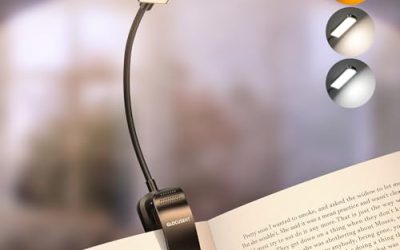
Glocusent Book Light, Reading the Host’s Notes as the Room Dims Second

The second job belongs to the dimming room. On the arm of the host’s chair rests one folded sheet, written out earlier in the day: the film’s title, its year, and the names of the players. Somewhere in the middle of the film a face on the screen raises a question nobody wants to ask out loud. Who played the harbour master. The page light is clipped to the top edge of that sheet and switched on for exactly as long as the answer takes, and no longer.
Thirteen LEDs run along the head of the light, and their entire responsibility is that single page. The beam pools low and close, a small warm oval on the paper and nothing beyond it. It does not wash onto the screen, does not catch a neighbour’s eye, and goes dark at a single touch. Nobody reaches for a phone. Nobody asks for the lamps.
The boundaries around this light are kept without exception. It is a page light only, never a room light, and it is never asked to stand in for one. In a car it belongs to passengers only, never the driver. Within those limits it does its one small job completely.
| Glocusent | 13 LED Book Light | B0FW4G86L7 | Book light with 13 LEDs, aimed at a page for reading programmes and notes in low light; not a substitute room light |
Pressman Checkers, Opening for the Unhurried Talk After the Credits Third

The third job is barely a job at all. When the credits finish and the lamps come up low, the checkers board comes off its shelf and opens on the low table between the chairs. It is simply there, pieces set, for the guests who are not ready to leave and for all the conversation the film postponed. An evening that began in amber light is in no hurry to end under lamplight either.
Checkers suits this hour because it may be the slowest game in the house. Two players, one board, and the pieces are the whole equipment list. There is nothing to charge, pair, update, or explain beyond the first move. A turn is one piece lifted and set down, and between turns there is room for everything the screening held back: what the film got right, what it missed, and the arguments it deferred to later. Voices stay low almost by themselves, because the game never gives anyone a reason to raise one.
The board is named plainly: a folding checkers board game for two players. Its most valuable part is not the board at all but the printed rules that come with it. Every friendly game produces one contested moment, a jump one player remembers as forced and the other as optional. Argued from memory, that moment can heat the whole room up again. Settled by the printed page, it ends in seconds: the passage is read aloud once, the ruling stands for both players alike, and the game moves on.
| Pressman | Checkers Folding Board Game | B00GPK8ISK | Folding checkers board game for two players; play by the rules printed with the game; folds flat for shelf or drawer storage between screenings |
MagicWater Crinkle Paper, Padding the Leaving Parcels Fourth

The fourth job waits by the door. Every family screening sends something home at the end of the night: a sealed jar of preserves, a closed tin, a capped bottle a guest has been told twice to take. Padding those parcels is quiet, unhurried work, done at the same pace as everything before it, so the goodbye never becomes a scramble.
The method is simple and slow. A handful of kraft strands is shaken loose between the palms until the tangle relaxes into a nest. The nest is pressed into the bottom of the parcel. The closed container is lowered in, and a second handful is worked around its shoulders so it cannot lean, knock, or roll on the drive home. Each finished parcel is lifted, tilted once, and listened to. Silence passes it. A faint shift sends it back for one more handful, and that is all the fuss the job is allowed.
One boundary governs this paper and is never bent. It is packaging filler only, never a food-contact material. The strands rest against glass, tin, and sealed lids, cushioning sealed items strictly from outside the seal. They never touch anything open, unwrapped, or edible, and a jar whose lid will not seat soundly does not travel at all.
| MagicWater | Crinkle Cut Paper 1LB Kraft | B0752BY9TP | Crinkle cut paper filler, 1 lb bag, kraft colour, for lining treat parcels around sealed items; packaging use only, not a food-contact material |
Krazy4K Stickers, Sealing the Thank-You Cards Last

The last job of the evening is the quietest. The cards owed from the last gathering have been waiting on the desk all week, and the lamplit end of an amber evening is when they finally get sealed. The house is settled, there is no audience and no deadline, which is exactly how a thank-you should be finished.
One sticker seals each card, and one is enough. The envelope lies flat, the flap is pressed smooth from the middle outward, and a single sticker closes it the way a full stop closes a sentence. A row of finished cards gathers along the edge of the desk, ready for the morning post.
The pack is named plainly for what it holds: one hundred Christian stickers, faith-themed on every sheet. Where the guests who visited share that faith, the little seal closes the card in the same language the welcome was given in. Where the company is mixed, the pack stays shut and the cards are handwritten instead, closed with the envelope’s own strip. That is not a thinner thank-you: the same gratitude, worded rather than pictured, so no guest is handed a faith message that is not theirs to receive. The stickers belong on smooth, dry paper and card only, never on food surfaces, walls, or furniture.
| Krazy4K | 100 Christian Stickers | B0C1TKDTHH | Pack of 100 Christian faith-themed stickers for marking programme cards, notebooks and envelopes; smooth dry paper and card surfaces only, not for food surfaces, walls or furniture |
How to Choose
Judge the hard case as exactly what it is: a wireless mic case doing a second job as latched storage, neither sealed nor waterproof, sized by whether your whole kit fits in one counted row. Judge the book light as a page light only, meant for one folded sheet of notes and nothing wider. Judge the checkers board by how flat it folds and how plainly its printed rules settle disputes. Judge the crinkle paper by how a handful springs loose into a nest, kept around sealed containers only. And judge the stickers by one question: does everyone gathered share their Christian faith theme? Where they do, seal the cards with them; where they do not, send every card handwritten and keep the pack shut.
Who Should Skip
Skip the hard case if your screening kit already lives together in one trusted place. Skip the book light if nobody reads a page during the film, or if what you need is a lamp for the whole room. Skip the checkers board if your guests always leave the moment the credits roll. Skip the crinkle paper if nothing in glass or tin ever travels home with anyone. And skip the stickers if your household does not share the Christian faith theme, or if thank-you cards are not your custom.
FAQ
Is the hard case sealed or waterproof?
Neither. It is a hard case made for a wireless mic system, repurposed here as latched storage for the screening kit. It lives indoors on a dry shelf, and nothing damp is stored inside.
What settles a disputed move in the checkers game?
The printed rules that come with the game. The passage is read aloud once, the ruling stands for both players alike, and the game moves on instead of turning into an argument from memory.
Can the crinkle paper touch the food inside a parcel?
No. The paper is packaging filler only, never a food-contact material. It cushions sealed jars, tins, and bottles strictly from outside the seal, so anything edible travels inside its closed container, untouched.
What if some guests do not share the stickers’ faith theme?
Then the pack stays shut and every card is handwritten instead, closed with the envelope’s own strip. The gratitude is the same; only the seal changes, so no guest receives a faith message that is not theirs.
Final Verdict
A slow amber screening is five unhurried certainties in the order the light sets. The CASEMATIX case takes the gathered kit first, latched shut, so the dark never sends anyone searching. The Glocusent book light reads the host’s notes second, a page light and nothing more. The Pressman checkers board opens third, its printed rules ready to settle any dispute, giving the evening a second life after the credits. The MagicWater crinkle paper nests the sealed jars and tins fourth, from outside the seal, as packaging filler only. And the Krazy4K Christian stickers seal the thank-you cards last, where their faith theme is shared, handwritten standing in where it is not, so the evening closes as slowly as the amber hour that opened it.
Product and ASIN Reference
| Product | ASIN |
|---|---|
| CASEMATIX Wireless Mic System Hard Case | B015WSQKEE |
| Glocusent 13 LED Book Light | B0FW4G86L7 |
| Pressman Checkers Folding Board Game | B00GPK8ISK |
| MagicWater Crinkle Cut Paper 1LB Kraft | B0752BY9TP |
| Krazy4K 100 Christian Stickers | B0C1TKDTHH |