Our Short List of 3

All 4 Picks at a Glance
| Product | Specs | Action |
|---|---|---|
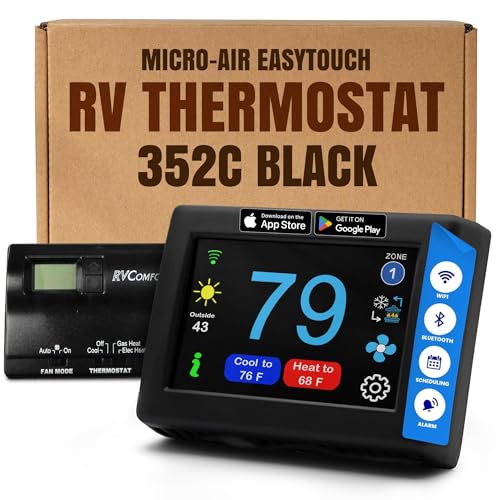
| 1. Micro-Air EasyTouch 352C, for Coleman Mach systems — ASIN B0BCH3CL9H | Check price on Amazon | |
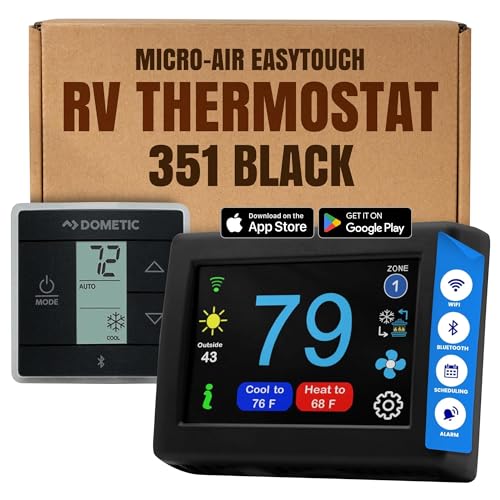
| 2. Micro-Air EasyTouch 351, for Dometic CT Single Zone systems — ASIN B0BCH5X2HB | Check price on Amazon | |
| 3. Micro-Air EasyTouch 353, for Furrion Chill systems — ASIN B0BCHF3VFY | Check price on Amazon | |
 4. Micro-Air EasyTouch 350, for Dometic CCC2 systems — ASIN B0BCH6N1TT | Check price on Amazon |
Key takeaways
- Compare the best WiFi thermostat for RV use: genuine 12V DC RV thermostats matched to Coleman Mach, Dometic and Furrion systems, with compatibility explained.
As an Amazon Associate we earn from qualifying purchases.
Affiliate Disclosure: This article contains affiliate links. If you buy through a link on this page, we may earn a commission at no extra cost to you. Product names, specifications and ASIN codes below come from the manufacturers’ and sellers’ product listings, and compatibility and availability should be confirmed on the product page before you order.
An RV thermostat looks like a smaller, simpler cousin of the thermostat on a hallway wall at home, and that resemblance causes real trouble. A residential smart thermostat is built around a twenty-four volt alternating current control system, usually powered through a common wire from a home furnace or air handler. An RV climate system is different at its foundations. RV air conditioners, furnaces and heat pumps are controlled from the vehicle’s twelve-volt direct current house system, the same low-voltage DC world that runs the lights, the water pump and the control boards. The wiring, the signals and the control boards behind the wall are not the home system in miniature. They are a separate standard, built by a small group of RV climate makers, principally Coleman Mach under Airxcel, Dometic and Furrion.
That is why this guide contains no household smart thermostats. A well-known home thermostat cannot simply be screwed to an RV wall and expected to run a roof air conditioner, and articles that quietly suggest otherwise leave readers with an expensive experiment. Every pick below is a genuine RV thermostat, designed for twelve-volt DC RV systems, with WiFi and Bluetooth control, from one maker whose entire product line exists to solve exactly this problem. The differences between the picks are not cosmetic. Each one replaces a different original thermostat family, and choosing correctly means matching your existing system first and shopping second.
The maker behind all four picks, and why that is normal here
The RV WiFi thermostat market is unusually concentrated. Micro-Air, a United States maker known in the marine and RV climate world, builds the EasyTouch RV range: touchscreen thermostats that replace specific original-equipment RV thermostats model for model, adding WiFi and Bluetooth control, a colour touchscreen and a smartphone app without monthly service fees, according to the listings. Because compatibility in this category is defined by which original thermostat and control system you already have, a responsible shortlist naturally contains several EasyTouch variants. They are distinct products, with distinct ASIN codes, distinct fitment lists and distinct wiring expectations, united by a shared platform. Think of them the way you would think of brake pads in different fitments: the brand is the same, but only one fitment belongs on your vehicle.
Each listing describes the same core experience once the correct model is fitted. A large colour touchscreen, roughly four inches wide by three inches high in the listing dimensions, replaces button-and-slider controls with direct touch adjustment that can be read in the dark. The thermostat automatically detects system sources such as the furnace, a heat strip and cooling, where those are fitted. The free smartphone app mirrors the wall controls, so you can monitor and adjust the air conditioner, furnace or heat pump over Bluetooth nearby or over WiFi from further away, cooling the cabin before you return from a hike or checking that the furnace is keeping pipes and pets safe on a cold night. The listings also describe free feature updates delivered through WiFi, which matters in a product category where the app is half of the product.
The four RV WiFi thermostats in this guide
1. Micro-Air EasyTouch 352C, for Coleman Mach systems — ASIN B0BCH3CL9H
The Micro-Air EasyTouch 352C in black, model ASY-352C-X03, ASIN B0BCH3CL9H, is the pick for the largest group of potential buyers: owners whose RVs run Coleman Mach, RV Comfort or Airxcel thermostats. Its listing states that the 352 series replaces Coleman Mach twelve-volt, RV Comfort heat pump, heat-cool and air conditioning thermostats across long lists of original model numbers, including button and switch models in the eighty-three hundred and eighty-five hundred series and push-button wire-insert models in the ninety-four hundred and ninety-six hundred series. If your current wall control says Coleman Mach or RV Comfort and its model number appears in that listing, this is the variant designed to take its place.
The listing’s technical details confirm the RV foundations that matter. The rated voltage is twelve volts DC, not the twenty-four volt AC of a home system. Connectivity is Bluetooth and WiFi, control is by app or touch, the display is a colour touchscreen with backlight, and the listed control functions cover heating, cooling and furnace operation. The thermostat is wall-mounted, rectangular, and listed with dimensions of about one inch deep, four inches wide and three inches high, so it covers a footprint in the same neighbourhood as the control it replaces rather than demanding new carpentry.
Choose this model only on evidence. Photograph your existing thermostat, read its maker and model number from the unit itself or its documentation, and match that number against the fitment list on the product page before ordering. Coleman-badged systems span many variants, and the EasyTouch range contains neighbouring models for related but different Coleman and RV Comfort sub-families, including zoned systems, which are covered by other variants in the range rather than by this one.
2. Micro-Air EasyTouch 351, for Dometic CT Single Zone systems — ASIN B0BCH5X2HB
The Micro-Air EasyTouch 351 in black, ASIN B0BCH5X2HB, serves the other giant of RV climate control: Dometic. Its listing describes it as the replacement for Dometic CT Single Zone thermostats, which makes its audience precise. A single-zone Dometic CT system controls one climate area, and this EasyTouch variant is built to step into that system’s place, bringing the same touchscreen, WiFi and Bluetooth app control and programmable behaviour described above to a Dometic-equipped RV.
Dometic fitment deserves the same discipline as Coleman fitment, because Dometic has used several distinct thermostat and control generations. CT Single Zone is one of them, and it is not interchangeable with the multi-zone CCC systems covered by the next pick or with the older five-button Dometic controls, which have their own EasyTouch variants elsewhere in the range. The listing for this model includes a thermostat guide to help buyers identify the correct replacement, and using it is not optional homework. In this category, the guide is the purchase decision: match the original thermostat family first, and only then enjoy choosing a colour and placing the order.
For a Dometic CT owner, the practical gains mirror those of the other picks. The cabin can be cooled before arrival, the furnace can be checked remotely during a cold snap, schedules can be programmed instead of remembered, and the dim, fiddly original control gives way to a backlit colour screen. None of those gains require changing the roof unit or the furnace, because the EasyTouch is a control replacement, not a climate system replacement, and that contained scope is exactly what makes the upgrade attractive.
3. Micro-Air EasyTouch 353, for Furrion Chill systems — ASIN B0BCHF3VFY
Furrion has become a common original fitment in newer RVs, and the Micro-Air EasyTouch 353 in black, model ET353X01 in the listing, ASIN B0BCHF3VFY, is the variant built for Furrion Chill digital thermostats. Related Micro-Air documentation lists the 353 series as replacing Furrion Chill digital thermostat models in the FACW range, while also naming specific Furrion models it does not replace, including manual-knob and certain single-zone variants. That explicit inclusion and exclusion list is a good sign in this category: it shows fitment being treated as an engineering boundary rather than a marketing suggestion.
If your RV came with a Furrion Chill system, this is your route to WiFi control without touching the roof unit. The platform benefits are the familiar ones: colour touchscreen on the wall, app control over WiFi and Bluetooth, programmable operation, automatic detection of connected heat and cool sources within the system’s design, and feature updates through WiFi with no monthly service fee described in the listings. The work of buying correctly is, again, verification. Confirm that your existing control is a Furrion Chill digital thermostat, confirm its model number against the listing, and pay attention to the named exclusions, because a Furrion badge alone is not a fitment guarantee.
Newer RV owners are the most likely to assume a household smart thermostat could be adapted, since their interiors look increasingly residential. The 353 exists precisely because that assumption fails at the control board. Buying the RV-specific control is not a compromise; it is the version engineered for the twelve-volt DC system your air conditioner and furnace actually use.
4. Micro-Air EasyTouch 350, for Dometic CCC2 systems — ASIN B0BCH6N1TT
The fourth pick, the Micro-Air EasyTouch 350 in black, ASIN B0BCH6N1TT, covers Dometic CCC2 systems, including replacements for CCC2 thermostats carrying the original model number 3314082 in the listings. CCC2 is Dometic’s comfort control generation used on many mid-range and larger RVs, including multi-zone installations, and it communicates with its control boards differently from the simpler CT Single Zone system covered by the 351 above. That difference is invisible from the driver’s seat and absolute at the wiring level, which is why the range keeps the two Dometic variants separate and why this guide does the same.
Listing material for the 350 family also notes, through related model descriptions, that the equivalent white variant replaces the same CCC2 originals, so colour is a genuine choice here while fitment is not. Owners of larger rigs with CCC2 controls gain the same remote monitoring story as everyone else in this guide, with an added premium on zone awareness: know which zones your system runs, confirm the listing’s description of your configuration, and set expectations in the app accordingly once fitted.
If your Dometic thermostat is a CCC2, do not order the 351 because it was the first Dometic result you found, and if yours is a CT, do not order this 350. The two mistakes are mirror images, equally easy to make and equally avoidable with one photograph and one model number.
Why household WiFi thermostats are not picks here
It is worth stating the exclusion plainly, because search results for this topic routinely mix categories. A residential WiFi thermostat expects a twenty-four volt AC control circuit, typically draws power through a common wire, and speaks to home furnaces, air handlers and heat pumps through standard home control wiring. An RV system runs its controls on twelve volts DC and uses maker-specific control boards and communication between the thermostat, the roof unit and the furnace. Those are different electrical languages. Adapting a home unit is not a matter of matching wire colours, and this guide does not present any home thermostat as an RV pick, silently or otherwise. If you ever see a home model recommended for an RV without a detailed, maker-supported compatibility explanation, treat that recommendation as a warning about the article, not as a discovery.
The honest limitation is therefore a strength of the picks above: each one declares its system, its voltage world and its replacement list in its listing, and your job is simply to match your RV to the declaration.
What WiFi control is actually worth in an RV
Remote control earns its keep in specific, repeatable moments. Cooling the cabin on the drive back to the campground, so the interior is habitable on arrival instead of an hour later. Checking, from a dinner table in town, that the furnace is holding a safe temperature for a dog resting in the rig. Receiving the reassurance that the air conditioner is still running on a hot afternoon when the RV is closed up and you are not. Programming a schedule that warms the cabin before an early start without running the furnace all night. None of these require exotic technology, but all of them require a thermostat that is genuinely connected and genuinely compatible, which is the entire point of choosing an RV-native model.
Remember the dependency, though: WiFi control needs a WiFi network the RV can join, whether that is campground infrastructure, your own hotspot or a router in the rig, and campground networks vary enormously in quality. Bluetooth control, which every pick here also lists, covers the nearby case without any network at all, including control from just outside the RV. A connected thermostat improves life when the network cooperates and remains a normal, fully usable wall thermostat when it does not, which is the correct order of priorities.
Installation and verification checklist
Before ordering, complete four checks. Identify the maker of your current thermostat from the unit itself. Record its exact model number, from the label or the manual, not from memory. Match that number against the fitment list on the specific product page for the variant you intend to buy, including any stated exclusions. Confirm your system type and zones: single zone or multi-zone, furnace or heat pump or heat strip, so the variant’s described control functions line up with your rig.
During installation, follow the maker’s instructions for your exact model, photograph the existing wiring before disconnecting anything, and cut power to the system as directed. The listings describe installation as a straightforward replacement process for the correct model, and that description depends on the word correct. After fitting, test heating and cooling from the wall first, then pair the app, join WiFi, and test remote control while you are still at home or at a site where a problem is easy to solve, rather than discovering a pairing issue on the first night of a trip.
How we chose, and the honest bottom line
This guide applied three filters. First, category truth: only thermostats designed for RV twelve-volt DC systems were considered, and household twenty-four volt AC models were excluded completely rather than included with caveats. Second, genuine connectivity: every pick lists WiFi and Bluetooth control with a smartphone app in its own product listing. Third, traceability: every pick carries its ASIN in its heading, its maker and the original system it replaces are named in the text, and the specifications quoted come from those listings rather than from any detailed research, which this guide does not claim to have performed. Availability, including whether a featured offer is live on a given listing on the day you shop, should be re-checked on the product page itself, and that final check is part of buying electronics in this category responsibly.
The best WiFi thermostat for RV use is therefore not a single box. It is the EasyTouch variant that matches the climate system already on your wall: the 352C for Coleman Mach, the 351 for Dometic CT Single Zone, the 353 for Furrion Chill, and the 350 for Dometic CCC2. Identify your system, buy its variant, and you get the touchscreen, the app and the remote peace of mind this upgrade promises, on the electrical standard your RV was actually built around.