Key takeaways
- Compare the best smart portable air conditioners with condensate pumps, drainage-free systems and app control, with BTU ratings, noise levels and specs.
Every portable air conditioner pulls moisture out of the air as it cools, and that water has to go somewhere. On a basic model it collects in an internal pan that fills up, triggers a warning code and shuts the cooling down until somebody empties it, which tends to happen in the middle of the night. The smarter models in this guide attack the problem at the design stage: self-evaporating systems blow condensate out with the hot exhaust air, and pump-equipped systems actively move the water to a hot coil where it evaporates, so the bucket routine mostly disappears.


All five units below are smart portable air conditioners with Wi-Fi app control and voice-assistant support, and each one was picked with condensate handling as a deciding factor. Every product section states plainly how that model deals with water, alongside its cooling ratings in both ASHRAE and DOE SACC figures, its coverage, noise level and smart features, so you can match a unit to your room size and your local humidity.
As an Amazon Associate, we earn from qualifying purchases.
Quick answer
The Whynter ARC-1030WN is the best overall pick: a 12,000 BTU ASHRAE (10,000 BTU SACC) dual-hose inverter portable AC with Wi-Fi control and a self-evaporating auto-drain system that sends condensate out with the exhaust air. For a true built-in pump, choose the Dreo AC516S; for the quietest cooling, the Midea Duo.
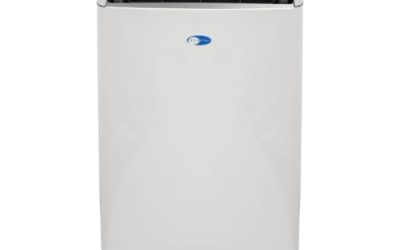
Whynter ARC-1030WN: Best overall
The ARC-1030WN balances capacity, efficiency and water handling better than anything else in this group. Its hose-in-hose dual-hose layout draws intake air from outside instead of pulling cooled air out of the room, and the NEX inverter compressor earns a CEER of 14.7, the highest efficiency figure among these five picks. Cooling is rated at 12,000 BTU ASHRAE and 10,000 BTU SACC for rooms up to 500 square feet, with Auto, Cool, Dry and Fan modes, a five-speed fan and a thermostat range of 60 to 86 degrees Fahrenheit.
Condensate is handled by Whynter’s patented auto-drain self-evaporation: in typical conditions the unit exhausts its condensate automatically along with the hot exhaust air, so there is nothing to empty. When humidity runs very high, an upper gravity drain port accepts a hose for continuous drainage, which is also the right setup for long Dry mode sessions, and a lower drain port plus an internal pan with a full alert serve as the backstop. Dehumidifying capacity is 82 pints per day.
Control runs through the NetHome Plus app, with Amazon Alexa and Google Home voice support, plus a handheld remote. Noise is listed at 42.5 dB on the low fan speed, rising to 53.5 dB on high, and the unit uses R32 refrigerant. The trade-offs are weight and scope: at 72.8 pounds it is a roll-it-don’t-carry-it machine, and it is cooling only, with no heat mode.
Key specs
- Cooling: 12,000 BTU ASHRAE / 10,000 BTU SACC
- Coverage: up to 500 sq ft
- Hose design: dual hose, hose-in-hose
- Efficiency: inverter compressor, CEER 14.7
- Noise: 42.5 dB on low
- Dehumidifying: 82 pints per day
- Smart control: NetHome Plus app, Alexa, Google Home, remote included
- Condensate: self-evaporating auto drain; upper gravity drain port and lower drain port
- Power: 115 V, up to 1,266 W
- Size and weight: 19.5 x 16.7 x 32.5 in, 72.8 lb
Whynter ARC-1230WN: Best for large rooms
The ARC-1230WN is the same NEX platform scaled up, and it carries the joint-highest DOE rating in this roundup: 14,000 BTU ASHRAE and 12,000 BTU SACC, with the largest maker-rated coverage here at 600 square feet. That makes it the natural pick for open-plan living areas, big primary bedrooms and other spaces where a 10,000 BTU SACC unit would run flat out all afternoon. It keeps the hose-in-hose dual-hose design, the inverter compressor (CEER 13.8) and the same NetHome Plus app, Alexa and Google Home control as its smaller sibling.
Its condensate story matches the ARC-1030WN: self-evaporating auto drain handles the water in normal cooling, sending it out through the exhaust hose. Because this model can pull 87 pints of moisture per day out of the air in Dry mode, continuous drainage matters more here; the upper gravity drain port takes a hose so Dry mode can run without filling the internal pan, and the lower port is there for manual emptying when needed.
Noise runs from 42.5 dB on low to 56.5 dB on high, the loudest top end in this group, which is the usual price of maximum output. Maximum power draw is 1,293 W at 11.9 amps, close to the practical limit of a shared household circuit, so check what else is on the line before plugging in. At 73.9 pounds in the same tall cabinet as the ARC-1030WN, it is best treated as a park-it-for-the-season unit.
Key specs
- Cooling: 14,000 BTU ASHRAE / 12,000 BTU SACC
- Coverage: up to 600 sq ft
- Hose design: dual hose, hose-in-hose
- Efficiency: inverter compressor, CEER 13.8
- Noise: 42.5 dB on low, 56.5 dB on high
- Dehumidifying: 87 pints per day
- Smart control: NetHome Plus app, Alexa, Google Home, remote included
- Condensate: self-evaporating auto drain; upper gravity drain port and lower drain port
- Power: 115 V, up to 1,293 W
- Size and weight: 19.5 x 16.7 x 32.5 in, 73.9 lb
Dreo AC516S: Best with a built-in condensate pump
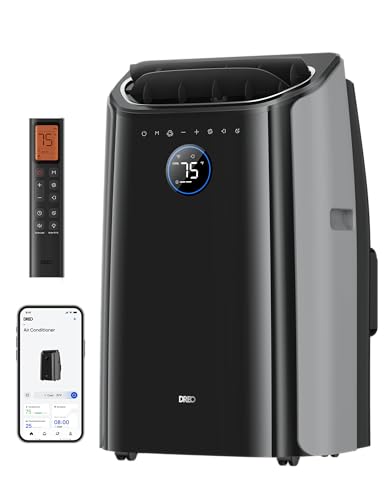
Most drainage-free claims rest on passive evaporation alone. The AC516S adds hardware: a built-in high-capacity water pump that channels collected condensate onto the hot evaporator coil, where it evaporates and leaves the room with the exhaust air. Dreo’s manual states that the system reduces drainage needs by about 90 percent in cooling mode when indoor humidity stays below 85 percent, which covers the great majority of homes and cooling days. A drain hose is included for Dry mode or for genuinely tropical humidity, when any portable will make water faster than it can evaporate it.
Cooling output is 14,000 BTU ASHRAE and 10,000 BTU DOE SACC, rated for rooms up to 400 square feet. It is a single-hose design, so it gives up some efficiency to the dual-hose Whynter and Midea models, but its noise isolation system holds the lowest setting to 46 dB, and the Dreo app offers a custom sleep curve alongside temperature and humidity readouts. Control options run to the Dreo app, Alexa, Google Home, Siri and the included remote, with Cool, Dry and Fan modes and a 24-hour timer.
If your one firm requirement is a pump inside the cabinet rather than evaporation alone, this is the verified pick in this group. Just size it honestly: 400 square feet is a bedroom or a modest living room, not an open-plan floor.
Key specs
- Cooling: 14,000 BTU ASHRAE / 10,000 BTU DOE SACC
- Coverage: up to 400 sq ft
- Hose design: single hose
- Noise: 46 dB on the lowest setting
- Smart control: Dreo app, Alexa, Google Home, Siri, remote included
- Condensate: built-in high-capacity pump feeds condensate to the evaporator; drainage-free cooling below 85 percent indoor humidity; drain hose included for Dry mode
- Modes: Cool, Dry, Fan
- Refrigerant: R32
- Size and weight: about 17.3 x 14.4 x 28.1 in, about 63 lb
Midea Duo MAP14S1TBL: Quietest
Midea rates the Duo at as low as 42 dB on its lowest setting, the lowest maker figure in this group, and the inverter compressor is the reason it can hold that level: it ramps output up and down smoothly instead of cycling a fixed-speed compressor on and off. This is the cooling-only Duo, rated at 14,000 BTU ASHRAE and 12,000 BTU SACC for rooms up to 550 square feet, so it matches the big Whynter on DOE-rated output while covering a slightly smaller area. The hose-in-hose design keeps intake and exhaust air in one combined duct, preserving the efficiency advantage of a dual-hose layout with a tidier window install.
Condensate in cooling mode is self-evaporative: moisture is evaporated and expelled through the exhaust, and routine draining is rarely part of the picture. The Duo has three drain outlets, and it pays to know which is which. The upper outlet takes the supplied drain hose for continuous drainage in Dry mode, the lower outlets empty the base pan when the unit needs it, and a P1 code on the display and in the app flags a full tank. Keeping the caps firmly on the outlets you are not using avoids the slow drips some owners report.
Smart control runs over Wi-Fi through Midea’s SmartHome app, with Alexa and Google Assistant voice support and a remote in the box. The main trade-off is bulk: at roughly 77 pounds this is one of the heaviest portables in its class, so plan on rolling it rather than lifting it, and give it a permanent parking spot for the season.
Key specs
- Cooling: 14,000 BTU ASHRAE / 12,000 BTU SACC
- Coverage: up to 550 sq ft
- Hose design: dual hose, hose-in-hose
- Compressor: inverter
- Noise: rated as low as 42 dB by Midea
- Smart control: SmartHome app over Wi-Fi, Alexa, Google Assistant, remote included
- Condensate: self-evaporative in cooling mode; upper outlet for continuous drainage in Dry mode; base pan drain outlets; P1 full-tank code
- Power: 115 V, 1,300 W
- Weight: about 77 lb
Dreo AC318S: Best budget

The AC318S brings the same drainage-free thinking as the AC516S down to a smaller, more affordable format for single small rooms. It is rated at 8,000 BTU ASHRAE and 5,000 BTU DOE SACC, which suits a small bedroom, a nursery or a compact home office rather than a living area. Inside, the same Dreo arrangement applies: a pump moves condensate to the evaporator so cooling mode runs without routine draining when indoor humidity is below 85 percent, and the included drain hose covers Dry mode and muggy stretches.
Noise is listed at 45 dB, respectable for a compact single-hose unit, and the control set is complete: Dreo app, Alexa and Google Home voice control, a remote, a 24-hour timer and a sleep function, across Cool, Dry and Fan modes. Nothing about the smart feature set feels cut down relative to the bigger Dreo; what you give up is reach and capacity, not convenience.
Buy it for the room it is sized for and it is the easiest entry point into pump-assisted, app-controlled cooling in this roundup. Ask it to cool a 400 square foot space and it will run constantly and still fall behind on a hot afternoon.
Key specs
- Cooling: 8,000 BTU ASHRAE / 5,000 BTU DOE SACC
- Coverage: small bedrooms and compact offices
- Hose design: single hose
- Noise: 45 dB
- Smart control: Dreo app, Alexa, Google Home, remote included
- Condensate: built-in pump feeds condensate to the evaporator; drainage-free cooling below 85 percent indoor humidity; drain hose for Dry mode
- Modes: Cool, Dry, Fan
- Timer: 24-hour
How to choose
Size by SACC, not ASHRAE. The ASHRAE number is the older, flattering rating; the DOE SACC figure accounts for heat leaking back through the hose and air infiltration, and it is the honest basis for comparison. Roughly, 5,000 BTU SACC handles a small bedroom, 10,000 BTU SACC a medium room, and 12,000 BTU SACC a large or open space.
Match the condensate system to your climate. In dry or moderate humidity, a self-evaporating model such as the Whynters or the Midea Duo will go weeks without attention in cooling mode. In humid regions, or if you plan to lean on Dry mode, favor a pump design like the Dreos or make sure the unit has an upper continuous-drain port and a floor drain or sink within hose reach.
Weigh hose design against noise. Dual-hose and hose-in-hose models cool faster and waste less of the air they just chilled. Inverter compressors, found in the Whynter and Midea picks, run quieter and hold temperature more evenly than fixed-speed designs.
Check the smart platform before buying. Each brand uses its own app: NetHome Plus for Whynter, SmartHome for Midea and the Dreo app for Dreo. All five picks work with Alexa and Google Assistant, and scheduling inside the app is what turns a portable into a set-and-forget appliance.
Mind the circuit. These units draw roughly 1,200 to 1,300 watts. A lightly loaded outlet circuit keeps the breaker happy, especially with the two largest models.
Who should skip
Skip this whole category if your window suits a window air conditioner or a U-shaped model: those cool the same room with less energy and less noise, because the hot half of the machine sits outside. Skip it, too, if you expect one portable to cool a whole apartment; every unit here is a one-room appliance, and open doorways do not change that.
Pass on these five if your space has no window or sliding door to vent through, since every portable must exhaust hot air somewhere. If your main use is heavy dehumidification in a damp basement with no drain access, even the pump models will need attention in Dry mode, so plan the drainage route before you buy. Finally, all five picks are cooling only; if shoulder-season heat matters, look at the heat-pump variants of these same lines instead.
Frequently Asked Questions
Do these air conditioners ever need manual draining?
In cooling mode, rarely, as long as humidity is moderate: the self-evaporating and pump designs dispose of condensate as part of normal running. In Dry mode, or during long humid spells, water can collect faster than it evaporates, and then you either connect the continuous drain hose or empty the pan when the full indicator appears. Treat draining as an occasional chore rather than a daily one.
What does a built-in condensate pump actually do?
It moves water mechanically instead of waiting for it to evaporate or be emptied by hand. In the Dreo models here, the pump lifts collected condensate onto the hot evaporator coil, where it turns to vapor and leaves through the exhaust hose. Other pump designs push water up and out through a hose to a sink. Either way, the pump removes the filled-pan shutdown and the bucket routine from everyday cooling.
Which cooling rating should I compare, ASHRAE or SACC?
Compare SACC to SACC. ASHRAE is the traditional bench rating and always reads higher; SACC is the Department of Energy’s seasonally adjusted figure that accounts for hose heat and infiltration losses in a real room. A unit rated 14,000 BTU ASHRAE and 12,000 BTU SACC cools like the second number, not the first.
Can I run these from a voice assistant or a schedule?
Yes. All five connect to Wi-Fi and work with Amazon Alexa and Google Assistant for power, temperature and mode changes, and each brand’s app adds scheduling, timers and sleep settings. Set a schedule in the app so the room is cool before bed or before you get home, then use voice for quick adjustments.
Final verdict
For most buyers, the Whynter ARC-1030WN is the one to get: dual-hose inverter cooling, the best efficiency figure here, and self-evaporating condensate handling that keeps maintenance near zero. Step up to the ARC-1230WN when the room is genuinely large. If a real internal pump is the deciding feature, the Dreo AC516S is built around exactly that, while the Midea Duo is the pick when quiet matters most. The Dreo AC318S covers small rooms on a tighter budget without giving up the pump system or the app control. Choose by SACC rating and by how your home handles humidity, and any of the five will cool without the nightly bucket ritual.
Product and ASIN Reference
| Product | ASIN |
|---|---|
| Whynter ARC-1030WN | B09TKT4PRT |
| Whynter ARC-1230WN | B09TP51PPH |
| Dreo AC516S | B0GQGJ6DML |
| Midea Duo MAP14S1TBL | B091CJVD2N |
| Dreo AC318S | B0DYV2MN4P |